Overview
Name
Named for an offshore island, Mozambique takes its name from Mussa bin BIQUE (or Mussa Ibn Malik), an influential Arab slave trader who set himself up as sultan there in the 15th century.
Source: CIA World Factbook · 2026-02-01 · text generated from this source, approved by a person
Geography
Between South Africa and Tanzania, Mozambique borders the Mozambique Channel in southeastern Africa. Its terrain includes mostly coastal lowlands, uplands in the center, high plateaus in the northwest, and mountains in the west. The Zambezi River flows through the north-central and most fertile part of the country.
Mozambique's natural resources include coal, titanium, natural gas, hydropower, tantalum, and graphite. Monte Binga is the highest point, while the Indian Ocean is the lowest point.
Source: CIA World Factbook · 2026-02-01 · text generated from this source, approved by a person
People and society
Mozambique's people include Makhuwa, Tsonga, Lomwe, Sena, and other African groups, alongside Mestizo people and people of European, Indian, Pakistani, and Chinese backgrounds. Catholic, Islam, Pentecostal, and Saio/Zione affiliations are found alongside people with no religion, Anglican affiliations, and other or unknown affiliations.
Large population clusters lie along the southern coast between Maputo and Inhambane, and in the central area between Beira and Chimoio along the Zambezi River. Another cluster is found in and around the northern cities of Nampula, Cidade de Nacala, and Pemba. The northwest and southwest are the least populated areas.
Source: CIA World Factbook · 2026-02-01 · text generated from this source, approved by a person
Government
The form of government is a presidential republic. Its legal system is a mixed system of Portuguese civil law and customary law. The latest constitution was adopted 16 November 2004 and took effect 21 December 2004. Independence came from Portugal on 25 June 1975. Independence Day, on 25 June (1975), is the national holiday.
Source: CIA World Factbook · 2026-02-01 · text generated from this source, approved by a person
Flag and symbols
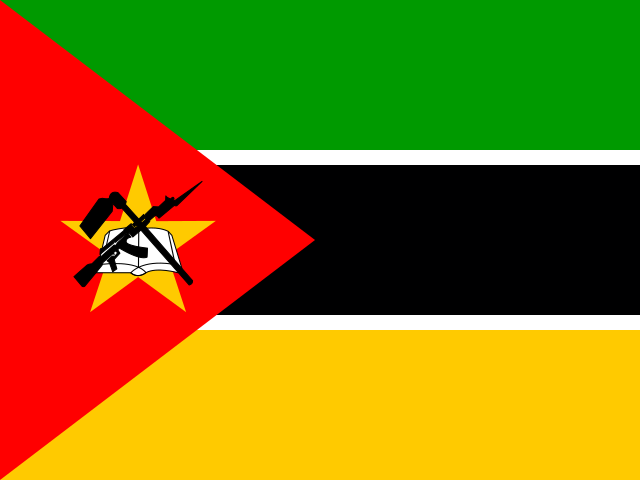
Three equal horizontal bands—green on top, black, and yellow—carry a red isosceles triangle at left. The triangle holds a five-pointed yellow star, crossed black-and-white rifle and hoe, and open white book; the black band is white-edged. Green stands for the riches of the land, white for peace, black for the African continent, yellow for the country's minerals, and red for the fight for independence. The rifle, hoe, and book are national symbols.
Source: CIA World Factbook · 2026-02-01 · text generated from this source, approved by a person
 Mozambique