Overview
Name
France's name derives from Latin "Francia", meaning "Land of the Franks." The Franks were Germanic tribes along the Rhine River in the 3rd century CE; their name may come from Old German "franka", meaning "brave," or the personal names Francio and Francus.
Source: CIA World Factbook · 2026-02-01 · text generated from this source, approved by a person
Climate
Metropolitan France has generally cool winters and mild summers, while the Mediterranean area has mild winters and hot summers. Occasional strong, cold, dry winds from the north to northwest are known as the mistral.
Source: CIA World Factbook · 2026-02-01 · text generated from this source, approved by a person
People and society
The population includes Celtic and Latin people, alongside Teutonic, Slavic, North African (Algerian, Moroccan, Tunisian), Indochinese, and Basque minorities. French is the official language; declining regional dialects and languages include Provençal, Breton, Alsatian, Corsican, Catalan, Basque, Flemish, Occitan, and Picard.
Roman Catholic, Muslim, Protestant, Buddhist, Orthodox, and Jewish communities are present, alongside people reporting no religion. People cluster in the north and southeast, while urban agglomerations extend throughout the country; Paris is by far the largest city, with Lyon a distant second.
Source: CIA World Factbook · 2026-02-01 · text generated from this source, approved by a person
Government
Its government is a semi-presidential republic. The legal system is civil law, with review of administrative but not legislative acts. The latest constitution took effect 4 October 1958, following many previous constitutions. No official independence date exists: 486 (Frankish tribes unified under Merovingian kingship) and 10 August 843 (Western Francia established from the division of the Carolingian Empire). Other listed dates include 14 July 1789 (French monarchy overthrown) and 22 September 1792 (First French Republic established). On 4 October 1958, the Fifth French Republic was established. Fête de la Fédération is the national holiday, on 14 July (1790).
Source: CIA World Factbook · 2026-02-01 · text generated from this source, approved by a person
Flag and symbols
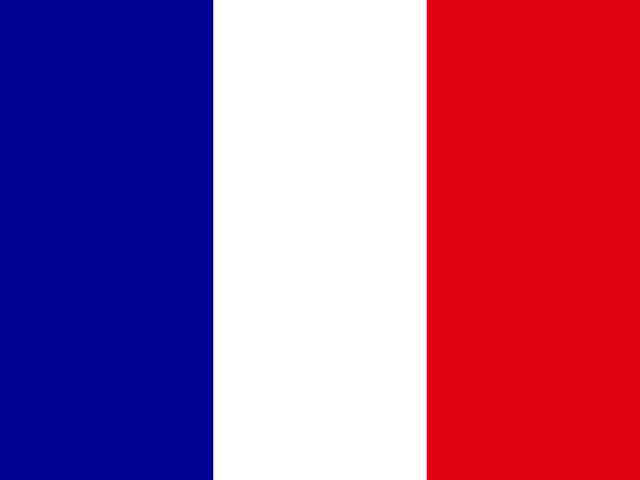
Three equal vertical bands of blue on the left, white, and red form the flag. Known as the le tricolore (tricolor), the flag dates to 1790 and the French Revolution, when the traditional color of white was combined with the blue and red of the Paris militia; its colors were initially ordered red, white, and blue. National symbols include the Gallic rooster, fleur-de-lis, and Marianne, the female personification of the country.
Source: CIA World Factbook · 2026-02-01 · text generated from this source, approved by a person
 France