Overview
Background
Regional states of the peninsula, along with Sardinia and Sicily, united under King Victor Emmanuel II to form a nation-state in 1861. Parliamentary government ended in the early 1920s, when Benito Mussolini established a Fascist dictatorship. Mussolini's alliance with Nazi Germany led to Italy's defeat in World War II. In 1946, a democratic republic replaced the monarchy, and economic revival followed.
Italy is a charter member of NATO and of the European Economic Community (EEC) and its successors, the EC and the EU. It has been at the forefront of European economic and political unification, joining the Economic and Monetary Union in 1999. Persistent problems include sluggish economic growth, high youth and female unemployment, organized crime, corruption, and economic disparities between southern Italy and the more prosperous north.
Source: CIA World Factbook · 2026-02-01 · text generated from this source, approved by a person
Geography
A peninsula in Southern Europe extends into the central Mediterranean Sea, northeast of Tunisia. The terrain is mostly rugged and mountainous, with some plains and coastal lowlands. Its strategic location dominates the central Mediterranean, as well as southern sea and air approaches to Western Europe.
Natural resources include coal, antimony, mercury, zinc, potash, marble, barite, asbestos, pumice, fluorspar, feldspar, pyrite, natural gas and crude oil reserves, fish, and arable land. Mont Blanc (Monte Bianco) de Courmayeur, a secondary peak of Mont Blanc, is the highest point. The Mediterranean Sea marks the lowest point.
Source: CIA World Factbook · 2026-02-01 · text generated from this source, approved by a person
Climate
Mediterranean conditions predominate, while the far north has an alpine climate and the south is hot and dry.
Source: CIA World Factbook · 2026-02-01 · text generated from this source, approved by a person
People and society
Coastal areas, the Po River Valley, and urban centers—particularly Milan, Rome, and Naples—attract larger and denser populations, while distribution is fairly even throughout most of the country. Italian people include small clusters of German-, French-, and Slovene-Italians in the north, alongside Albanian-Italians, Croat-Italians, and Greek-Italians in the south.
Italian is official; parts of Trentino-Alto Adige region are predominantly German-speaking, with French in Valle d'Aosta region, Slovene in the Trieste-Gorizia area, and Croatian in Molise. Religious affiliations include Christians, overwhelmingly Roman Catholic, with very small groups of Jehovah's Witnesses and Protestants, as well as Muslims and unaffiliated people.
Source: CIA World Factbook · 2026-02-01 · text generated from this source, approved by a person
Government
Governance takes the form of a parliamentary republic. Its civil law system includes a Constitutional Court that reviews legislation under certain conditions. The current constitution was enacted 22 December 1947, adopted 27 December 1947, and entered into force 1 January 1948. Independence dates to 17 March 1861. Its national holiday is Republic Day, 2 June (1946).
Source: CIA World Factbook · 2026-02-01 · text generated from this source, approved by a person
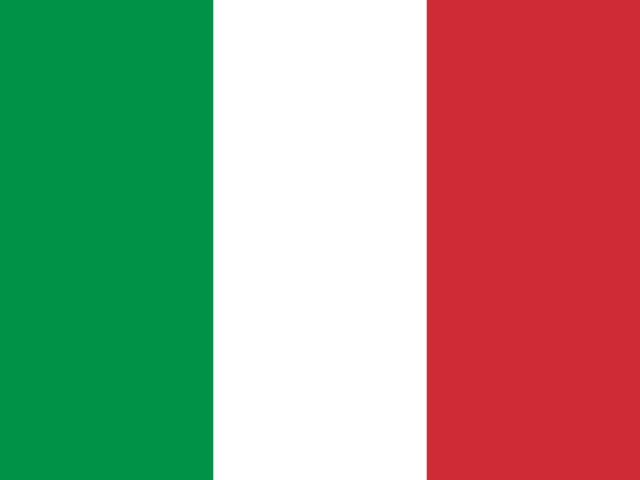 Italy
Italy