Overview
Geography
The Julian Alps lie between Austria and Croatia, and Slovenia lies in south Central Europe. On the Adriatic, Slovenia has a short southwestern coastal strip of Karst topography. To the north, an alpine mountain region lies adjacent to Italy and Austria. To the east, the landscape has mixed mountains and valleys with numerous rivers.
Slovenia's natural resources include lignite, lead, zinc, building stone, hydropower, and forests. Despite its small size, this eastern Alpine country controls some of Europe's major transit routes. Triglav is the country's highest point. The Adriatic Sea is the country's lowest point.
Source: CIA World Factbook · 2026-02-01 · text generated from this source, approved by a person
Climate
The coast has a Mediterranean climate, while the plateaus and valleys to the east have a continental climate, with mild to hot summers and cold winters.
Source: CIA World Factbook · 2026-02-01 · text generated from this source, approved by a person
People and society
A fairly even distribution runs throughout most of the country, while urban areas attract larger, denser populations. Pockets in the mountainous northwest are less dense. Its people include Slovene, Serb, Croat, Bosniak, and others.
Slovene is official, while Croatian, Serbo-Croatian, Bosnian, and Serbian are spoken alongside Hungarian and Italian, also official in municipalities where their nationals reside. Religious responses include Catholic, Orthodox, Muslim, Christian, atheist, non-believer/agnostic, and other; some people refused to answer.
Source: CIA World Factbook · 2026-02-01 · text generated from this source, approved by a person
Government
A parliamentary republic, Slovenia uses a civil law system. The latest constitution was passed by Parliament 23 December 1991; the previous constitution dated from 1974, before independence. Its independence from Yugoslavia dates to 25 June 1991. The national holiday, Independence Day/Statehood Day, falls on 25 June (1991).
Source: CIA World Factbook · 2026-02-01 · text generated from this source, approved by a person
Flag and symbols
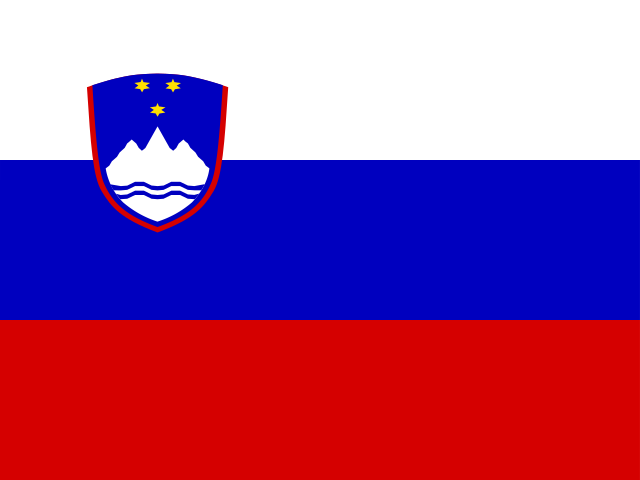
Three equal horizontal bands—white at the top, blue in the middle, and red below—form Slovenia's flag. At the center, the Slovenian seal shows Triglav, the country's highest peak, in white on a blue shield, with two wavy blue lines under it. The three six-pointed stars in an inverted triangle on the upper-left come from the coat of arms of the Counts of Celje, a Slovene dynastic house. The wavy lines represent seas and rivers, while the colors come from the medieval coat of arms of the Duchy of Carniola. Mount Triglav is Slovenia's national symbol.
Source: CIA World Factbook · 2026-02-01 · text generated from this source, approved by a person
 Slovenia