6 cities

Location of El SalvadorGuatemalaHondurasMexicoNicaraguaEl SalvadorSanta AnaUsulutanSonsonateNueva San SalvadorSan MiguelSan Salvador
Country

El Salvador

13.69° N, 88.89° W

Fertility rate of 1.4 children per woman — the 28th lowest of 225 countries.

fertility rate 1.4 children per woman · 198th/225
CIA World Factbook · 2026-02-01 · ranks computed across the countries in this atlas that carry the value

Population
6,453,553
Area
21,041 km²
Population density
≈ 318 / km²
Capital
San Salvador
Natural Earth
ISO codes
SV · SLV
GDP (nominal)
$35.37 billion
GDP per capita (PPP)
$11,700
How big, reallyDrawn at the same scale as eSwatini. Equal-area projection, not the map you are used to.
El Salvador 21,041 km²eSwatini 17,364 km²

geometry: Natural Earth 1:50m · EPSG:6933 equal-area

Where El Salvador sits in the world

Each line is every country in this atlas that carries the value, ordered smallest to largest. The line down the middle is the world median; the mark on each line is this country.

  1. Median age31.2 years125th of 224 · median 32.6 years
  2. Life expectancy75.9 years118th of 224 · median 76.2 years
  3. Fertility rate1.4 children per woman198th of 225 · median 1.92 children per woman
  4. Population6,453,553112th of 235 · median 5,454,073
  5. Total area21,041 km²152nd of 228 · median 83,736 km²
  6. Coastline307 km130th of 229 · median 402 km

Overview

Name

Meaning "the Savior" in Spanish, El Salvador shortens "the Divine Savior of the World," a reference to Jesus Christ. Spanish colonists named a fort San Salvador; the name later extended to the city and surrounding region, and the country adopted El Salvador officially in 1824.

Source: CIA World Factbook · 2026-02-01 · text generated from this source, approved by a person

Background

Independence from Spain came in 1821, followed by independence from the Central American Federation in 1839.

A civil war ended in 1992, when the government and leftist rebels signed a treaty providing for military and political reforms. El Salvador is beset by one of the world's highest homicide rates and pervasive criminal gangs.

Source: CIA World Factbook · 2026-02-01 · text generated from this source, approved by a person

People and society

Mestizo, White, Indigenous, and Black people live in El Salvador, alongside others; Indigenous groups include Lenca, Kakawira, and Nahua-Pipil. Spanish is the official language, while some Indigenous people speak Nawat.

People identify as Roman Catholic or Protestant, including Evangelical, Evangelical-Methodist, and Evangelical-Baptist, or report no religion; some affiliations are unspecified. El Salvador has high population density country-wide, with particular concentration around the capital of San Salvador.

Source: CIA World Factbook · 2026-02-01 · text generated from this source, approved by a person

Government

A presidential republic governs El Salvador. Its civil law system has minor common law influence, and the Supreme Court reviews legislative acts. The latest constitution was drafted 16 December 1983 and enacted 23 December 1983. Independence dates to 15 September 1821 from Spain. The national holiday is Independence Day, 15 September (1821).

Source: CIA World Factbook · 2026-02-01 · text generated from this source, approved by a person

Flag and symbols

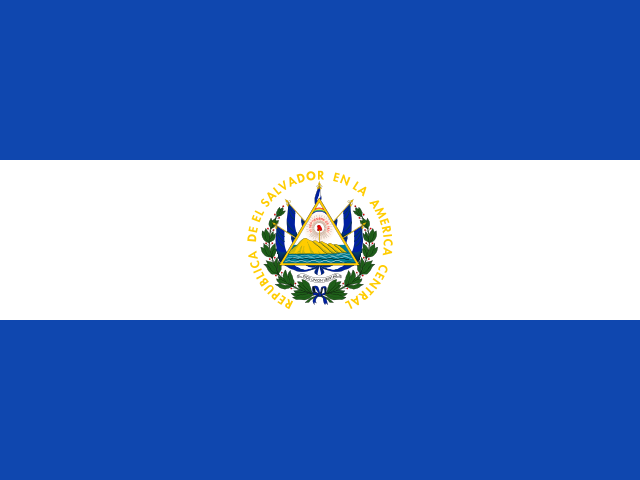
Three equal horizontal bands of cobalt blue, white, and cobalt blue form the flag, with the national coat of arms centered in the white band. Its round emblem has the words REPUBLICA DE EL SALVADOR EN LA AMERICA CENTRAL around it. The blue bands stand for the Pacific Ocean and the Caribbean Sea, and the white for the land, peace, and prosperity. The turquoise-browed motmot is the national symbol.

Source: CIA World Factbook · 2026-02-01 · text generated from this source, approved by a person
Key figures

CIA World Factbook

Economy

GDP (nominal)
$35.37 billion
GDP (PPP)
$73.96 billion
GDP per capita (PPP)
$11,700
GDP growth
+2.6%
Inflation (consumer prices)
0.9%
Unemployment
2.9%
Exports
$11.59 billion
Imports
$18.35 billion

People

Life expectancy
75.9 years
Median age
31.2 years
Birth rate
12.46 per 1,000
Death rate
5.93 per 1,000
Fertility rate
1.4 children per woman
Population growth
+0.34% a year
Urban population
75.4%
Literacy
89.8%
Languages
  • Spanishofficial
  • Nawat
Religions
  • Roman Catholic43.9%
  • Protestant39.6%Evangelical - unspecified 38.2%, Evangelical - Methodist 1.3%, Evangelical - Baptist 0.1%
  • other0.2%

Land

Total area
21,041 km²Land 20,721 km² · Water 320 km²
Coastline
307 km
Land borders
590 km
Mean elevation
442 m
Highest point
2,730 m Cerro El Pital

Values from the CIA World Factbook archive. Each carries the year it describes; open a year for the exact source field.

Connections

Natural geography 1

Natural Earth outlines · features with a Wikidata ID

Largest cities 6

Population · Natural Earth

  1. San Salvadorcapital1.4M
  2. Santa Ana234.5K
  3. San Miguel201.6K
  4. Sonsonate168.9K
  5. Nueva San Salvador124.7K
  6. Usulutan51.9K

Sources