Overview
Name
Meaning "the Savior" in Spanish, El Salvador shortens "the Divine Savior of the World," a reference to Jesus Christ. Spanish colonists named a fort San Salvador; the name later extended to the city and surrounding region, and the country adopted El Salvador officially in 1824.
Source: CIA World Factbook · 2026-02-01 · text generated from this source, approved by a person
Background
Independence from Spain came in 1821, followed by independence from the Central American Federation in 1839.
A civil war ended in 1992, when the government and leftist rebels signed a treaty providing for military and political reforms. El Salvador is beset by one of the world's highest homicide rates and pervasive criminal gangs.
Source: CIA World Factbook · 2026-02-01 · text generated from this source, approved by a person
People and society
Mestizo, White, Indigenous, and Black people live in El Salvador, alongside others; Indigenous groups include Lenca, Kakawira, and Nahua-Pipil. Spanish is the official language, while some Indigenous people speak Nawat.
People identify as Roman Catholic or Protestant, including Evangelical, Evangelical-Methodist, and Evangelical-Baptist, or report no religion; some affiliations are unspecified. El Salvador has high population density country-wide, with particular concentration around the capital of San Salvador.
Source: CIA World Factbook · 2026-02-01 · text generated from this source, approved by a person
Government
A presidential republic governs El Salvador. Its civil law system has minor common law influence, and the Supreme Court reviews legislative acts. The latest constitution was drafted 16 December 1983 and enacted 23 December 1983. Independence dates to 15 September 1821 from Spain. The national holiday is Independence Day, 15 September (1821).
Source: CIA World Factbook · 2026-02-01 · text generated from this source, approved by a person
Flag and symbols
Three equal horizontal bands of cobalt blue, white, and cobalt blue form the flag, with the national coat of arms centered in the white band. Its round emblem has the words REPUBLICA DE EL SALVADOR EN LA AMERICA CENTRAL around it. The blue bands stand for the Pacific Ocean and the Caribbean Sea, and the white for the land, peace, and prosperity. The turquoise-browed motmot is the national symbol.
Source: CIA World Factbook · 2026-02-01 · text generated from this source, approved by a person
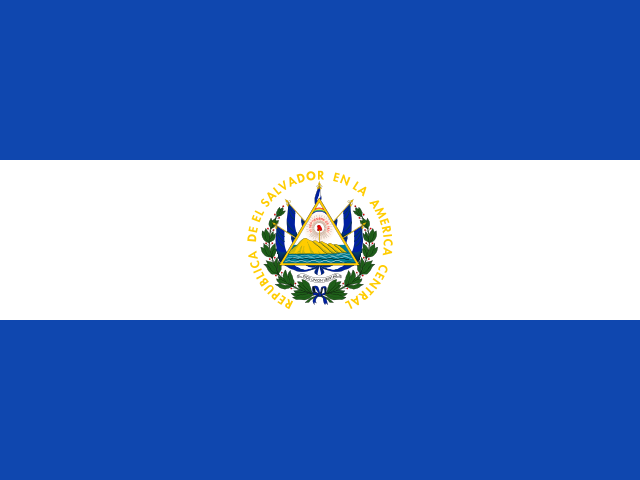 El Salvador