Overview
Name
The name Guatemala probably comes from "Quauhtemallan," a name used by Nahuatl-speaking Mexican allies for a former Mayan settlement. It means "land of the eagle," and the Spanish probably pronounced it "Guatemala."
Source: CIA World Factbook · 2026-02-01 · text generated from this source, approved by a person
Geography
Guatemala occupies Central America, bordering the North Pacific Ocean between El Salvador and Mexico. It also borders the Gulf of Honduras (Caribbean Sea) between Honduras and Belize. Two east-west trending mountain chains divide the country into three regions: the mountainous highlands, the Pacific coast south of the mountains, and the vast northern Peten lowlands.
Although Guatemala has eastern and western coastlines on the Caribbean Sea and Pacific Ocean, it has no natural harbors on the west coast. Guatemala lies along the Ring of Fire, a belt bordering the Pacific Ocean. Volcan Tajumulco is the highest point in Central America. The country's lowest point is the Pacific Ocean. Natural resources include petroleum, nickel, rare woods, fish, chicle, and hydropower.
Source: CIA World Factbook · 2026-02-01 · text generated from this source, approved by a person
Climate
A tropical climate brings hot, humid conditions to Guatemala's lowlands, while the highlands are cooler.
Source: CIA World Factbook · 2026-02-01 · text generated from this source, approved by a person
People and society
Mestizo people, called Ladino in local Spanish, are mixed Indigenous-Spanish; Maya, Xinca, African descent, Garifuna, and foreign residents also form part of the population. Garifuna combine West and Central African, Island Carib, and Arawak backgrounds.
Spanish is the official language, while Maya languages include Q'eqchi', K'iche, Mam, Kaqchikel, Q'anjob'al, Poqomchi', and other varieties. Xinca and Garifuna are included among the other languages. Religious affiliations include Evangelical and Roman Catholic, as well as no religion and unspecified affiliations. The population resides in the southern half, particularly in mountainous regions, and many people live in rural areas.
Source: CIA World Factbook · 2026-02-01 · text generated from this source, approved by a person
Government
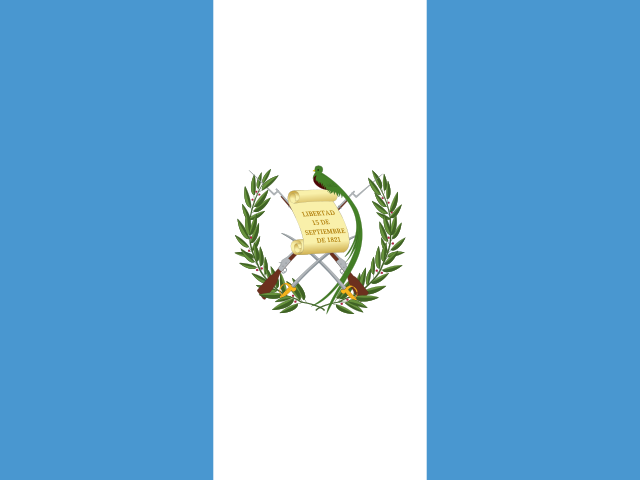
A presidential republic governs Guatemala. Its legal system is based on civil law and includes judicial review of legislative acts. The latest constitution was adopted 31 May 1985 and took effect on 14 January 1986. Guatemala gained independence from Spain on 15 September 1821. Its national holiday is Independence Day, 15 September (1821).
Source: CIA World Factbook · 2026-02-01 · text generated from this source, approved by a person
 Guatemala