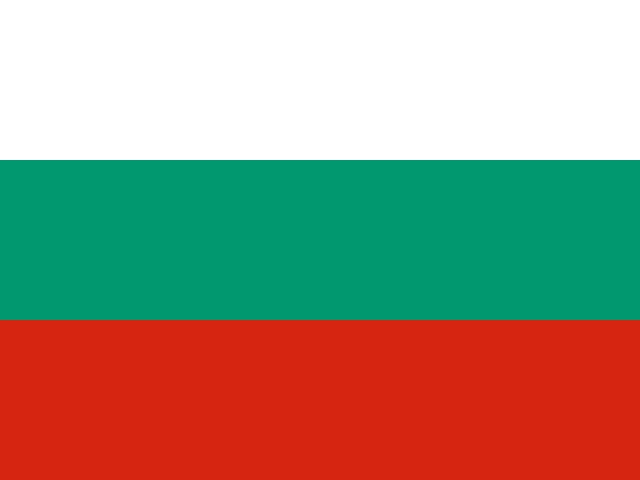
15 cities

Location of BulgariaItalyNorth MacedoniaBosnia and HerzegovinaGreeceMoldovaKosovoTürkiyeAustriaAlbaniaCroatiaSloveniaUkraineRomaniaHungarySerbiaMontenegroBulgariaSofiaDobrichShumenPlovdivBurgasRusePlevenStara ZagoraVarnaSliven
Country

Bulgaria

42.51° N, 25.16° E

For every 7.88 per 1,000 births there are 14.18 per 1,000 deaths — the population is falling 0.66% a year.

population growth -0.66% · 217th/230 · birth rate 7.88 per 1,000 · 205th/226 · death rate 14.18 per 1,000 · 6th/226
CIA World Factbook · 2026-02-01 · ranks computed across the countries in this atlas that carry the value

Population
6,975,761
Area
110,879 km²
Population density
≈ 62 / km²
Capital
Sofia
Natural Earth
ISO codes
BG · BGR
GDP (nominal)
$112.21 billion
GDP per capita (PPP)
$34,100
How big, reallyDrawn at the same scale as Portugal. Equal-area projection, not the map you are used to.
Bulgaria 110,879 km²Portugal 92,090 km²

geometry: Natural Earth 1:50m · EPSG:6933 equal-area

Where Bulgaria sits in the world

Each line is every country in this atlas that carries the value, ordered smallest to largest. The line down the middle is the world median; the mark on each line is this country.

  1. Median age45.5 years19th of 224 · median 32.6 years
  2. Life expectancy76.1 years113th of 224 · median 76.2 years
  3. Fertility rate1.52 children per woman179th of 225 · median 1.92 children per woman
  4. Population6,975,761106th of 235 · median 5,454,073
  5. Total area110,879 km²105th of 228 · median 83,736 km²
  6. Coastline354 km124th of 229 · median 402 km

Overview

Background

A Central Asian Turkic tribe, the Bulgars merged with local Slavic inhabitants in the late 7th century to form the first Bulgarian state. In succeeding centuries, Bulgaria struggled with the Byzantine Empire to assert its place in the Balkans. By the end of the 14th century, the Ottoman Turks overran the country. Northern Bulgaria attained autonomy in 1878, and all of Bulgaria became independent from the Ottoman Empire in 1908.

Having fought on the losing side in both World Wars, Bulgaria fell within the Soviet sphere of influence and became a People's Republic in 1946. Communist domination ended in 1990, when Bulgaria held its first multiparty election since World War II. The country then began the contentious process of moving toward political democracy and a market economy while combating inflation, unemployment, corruption, and crime. It joined NATO in 2004, the EU in 2007, and the Schengen Area for air and sea travel in 2024.

Source: CIA World Factbook · 2026-02-01 · text generated from this source, approved by a person

Climate

Cold, damp winters and hot, dry summers mark a temperate climate.

Source: CIA World Factbook · 2026-02-01 · text generated from this source, approved by a person

People and society

The population includes Bulgarian, Turkish and Roma people, as well as others. Bulgarian is the official language, while Turkish and Romani are also spoken.

People identify as Christian or Muslim, with others following different religions or none. People are distributed fairly evenly throughout most of the country, while urban areas attract larger populations.

Source: CIA World Factbook · 2026-02-01 · text generated from this source, approved by a person

Government

A parliamentary republic is Bulgaria's form of government. Its legal system is based on civil law. The current constitution was drafted between late 1990 and early 1991 and adopted 13 July 1991, after several previous constitutions. Independence came on 3 March 1878 as an autonomous principality within the Ottoman Empire, followed by complete independence from the Ottoman Empire on 22 September 1908. Liberation Day, 3 March (1878), is the national holiday.

Source: CIA World Factbook · 2026-02-01 · text generated from this source, approved by a person

Key figures

CIA World Factbook

Economy

GDP (nominal)
$112.21 billion
GDP (PPP)
$219.65 billion
GDP per capita (PPP)
$34,100
GDP growth
+2.8%
Inflation (consumer prices)
2.4%
Unemployment
4.2%
Exports
$62.66 billion
Imports
$60.03 billion

People

Life expectancy
76.1 years
Median age
45.5 years
Birth rate
7.88 per 1,000
Death rate
14.18 per 1,000
Fertility rate
1.52 children per woman
Population growth
-0.66% a year
Urban population
76.7%
Languages
  • Bulgarianofficial77.3%
  • Turkish7.9%
  • Romani3.5%
  • others10.4%
Religions
  • Christian64.7%
  • Muslim9.8%
  • other20.7%

Land

Total area
110,879 km²Land 108,489 km² · Water 2,390 km²
Coastline
354 km
Land borders
1,806 km
Mean elevation
472 m
Highest point
2,925 m Musala

Values from the CIA World Factbook archive. Each carries the year it describes; open a year for the exact source field.

Connections

Natural geography 3

Natural Earth outlines · features with a Wikidata ID

Seas 1

Mountain ranges 1

Peninsulas 1

Largest cities 15

Population · Natural Earth

  1. Sofiacapital1.2M
  2. Plovdiv340.5K
  3. Varna312.8K
  4. Burgas196K
  5. Ruse184.3K
  6. Stara Zagora143.4K
  7. Pleven118.7K
  8. Sliven96.4K
  9. Dobrich94.8K
  10. Shumen87.3K
  11. Pernik82.5K
  12. Khaskovo79.7K

Sources