Name
The name derives from the Latin "Romani," meaning "people from Rome," and the current name was adopted when Moldavia and Wallachia merged in 1861.
Source: CIA World Factbook · 2026-02-01 · text generated from this source, approved by a person
 Romania
45.73° N, 24.97° E
For every 8.45 per 1,000 births there are 14.28 per 1,000 deaths — the population is falling 0.86% a year.
population growth -0.86% · 222nd/230 · birth rate 8.45 per 1,000 · 197th/226 · death rate 14.28 per 1,000 · 5th/226
CIA World Factbook · 2026-02-01 · ranks computed across the countries in this atlas that carry the value
geometry: Natural Earth 1:50m · EPSG:6933 equal-area
Each line is every country in this atlas that carries the value, ordered smallest to largest. The line down the middle is the world median; the mark on each line is this country.
The name derives from the Latin "Romani," meaning "people from Rome," and the current name was adopted when Moldavia and Wallachia merged in 1861.
Source: CIA World Factbook · 2026-02-01 · text generated from this source, approved by a person
A temperate climate brings cold, cloudy winters with frequent snow and fog, and sunny summers with frequent showers and thunderstorms.
Source: CIA World Factbook · 2026-02-01 · text generated from this source, approved by a person
Romanian, Hungarian, Romani, Ukrainian, and German communities are among the country's ethnic groups. Romanian is the official language, alongside Hungarian, Romani, and other languages.
The country's religious affiliations include Romanian Orthodox, Roman Catholic, Reformed, Pentecostal, and others. Urbanization is not particularly high, and population distribution is fairly even throughout most of the country, while urban areas attract larger and denser populations.
Source: CIA World Factbook · 2026-02-01 · text generated from this source, approved by a person
Its government is a semi-presidential republic. It uses a civil law system. The latest constitution was adopted 21 November 1991, approved by referendum, and took effect 8 December 1991. Independence was proclaimed from the Ottoman Empire on 9 May 1877 and recognized by the Treaty of Berlin on 13 July 1878. Unification Day marks the unification of Romania and Transylvania in 1918 and is observed on 1 December.
Source: CIA World Factbook · 2026-02-01 · text generated from this source, approved by a person
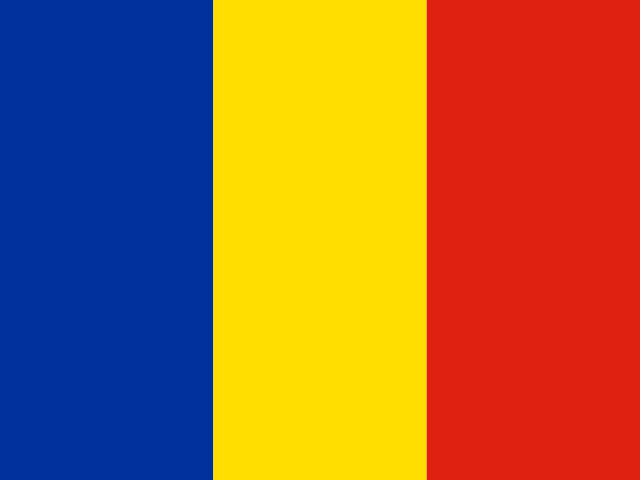
Three equal vertical bands of blue on the left, yellow, and red form the flag. The colors come from the principalities of Walachia, whose colors were red and yellow, and Moldavia, whose colors were red and blue; they united in 1862 to form Romania. The design was modeled on the French flag, and the national coat of arms that used to be centered on the yellow band has been removed. The national symbol is the golden eagle.
Source: CIA World Factbook · 2026-02-01 · text generated from this source, approved by a person
CIA World Factbook
Values from the CIA World Factbook archive. Each carries the year it describes; open a year for the exact source field.
Natural Earth outlines · features with a Wikidata ID
Population · Natural Earth