Overview
Name
Its name comes from the ruling dynasty, the House of Saud. The name Arabia can be traced back at least as far as the ancient Romans, who referred to the peninsula as "Arabia Felix" (Arabia the Fortunate).
Source: CIA World Factbook · 2026-02-01 · text generated from this source, approved by a person
Geography
Without a river, Saudi Arabia is the world's largest country without one. In the Middle East, Saudi Arabia borders the Persian Gulf and the Red Sea and lies north of Yemen. Mostly sandy desert covers the country's terrain.
The country's natural resources include petroleum, natural gas, iron ore, gold, and copper. Its extensive coastlines on the Persian Gulf and Red Sea allow considerable shipping, especially of crude oil, through the Persian Gulf and Suez Canal. The highest point lies in the As Sarawat range. The lowest point is at the Persian Gulf.
Source: CIA World Factbook · 2026-02-01 · text generated from this source, approved by a person
Climate
The climate is a harsh, dry desert with great temperature extremes. Frequent sand and dust storms are natural hazards.
Source: CIA World Factbook · 2026-02-01 · text generated from this source, approved by a person
People and society
Arab and Afro-Asian people form the country's ethnic groups. Arabic is the official language. Muslim is the official religion; citizens are Sunni and Shia, while other affiliations include Eastern Orthodox, Protestant, Roman Catholic, Jewish, Hindu, Buddhist, and Sikh.
Historically nomadic or semi-nomadic, the Saudi population became more settled after oil was discovered. The population is concentrated across a wide area in the middle of the peninsula. That area extends from Ad Dammam in the east through Riyadh in the interior to Mecca-Medina in the west near the Red Sea.
Source: CIA World Factbook · 2026-02-01 · text generated from this source, approved by a person
Government
An absolute monarchy governs Saudi Arabia. The legal system is an Islamic (sharia) system with some elements of Egyptian, French, and customary law, and commercial disputes are handled by special committees. Issued by royal decree on 1 March 1992, the Basic Law of Government serves as the constitutional framework. It is based on the Qur'an and the life and traditions of the Prophet Muhammad. Saudi Arabia's independence dates to 23 September 1932, the unification of the kingdom. Saudi National Day (Unification of the Kingdom) falls on 23 September (1932).
Source: CIA World Factbook · 2026-02-01 · text generated from this source, approved by a person
Flag and symbols
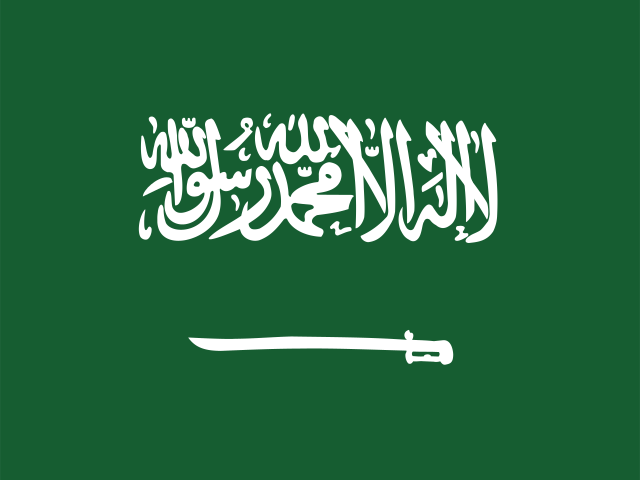
A green flag, the traditional Islamic color, bears the Shahada, or Muslim creed, in large white Arabic script above a white horizontal saber pointing left. Its design is associated with the Al Saud family, which established the kingdom in 1932; different sides let text read right to left and the saber point the same way on both sides. The national symbol is a palm tree over two crossed swords.
Source: CIA World Factbook · 2026-02-01 · text generated from this source, approved by a person
 Saudi Arabia