Name
The name may derive from the Arabic word "katran," meaning "tar" or "resin," in reference to the area's oil and natural gas reserves.
Source: CIA World Factbook · 2026-02-01 · text generated from this source, approved by a person
 Qatar
Qatar25.24° N, 51.14° E
99.4% of everyone here lives in a city.
urban population 99.4% · 12th/225
CIA World Factbook · 2026-02-01 · ranks computed across the countries in this atlas that carry the value
geometry: Natural Earth 1:50m · EPSG:6933 equal-area
Each line is every country in this atlas that carries the value, ordered smallest to largest. The line down the middle is the world median; the mark on each line is this country.
The name may derive from the Arabic word "katran," meaning "tar" or "resin," in reference to the area's oil and natural gas reserves.
Source: CIA World Factbook · 2026-02-01 · text generated from this source, approved by a person
Pearling once marked a poor British protectorate ruled by the Al Thani family since the mid-1800s. Qatar transformed itself into an independent state with significant hydrocarbon revenues. In 1995, Hamad bin Khalifa Al Thani overthrew his father in a bloodless coup and introduced wide-sweeping political and media reforms. He also pursued unprecedented economic investment and a growing regional leadership role through Al-Jazeera and mediation of some regional conflicts.
Qatar did not experience domestic unrest or violence like that seen in other Near Eastern and North African countries in 2011, due in part to its immense wealth and patronage network. In mid-2013, Hamad peacefully abdicated to his son, Tamim bin Hamad, who expanded infrastructure for international sporting events before Qatar hosted the FIFA Men’s World Cup in 2022. After supporting many popular revolutions, particularly in Libya and Syria, Doha saw relations with Bahrain, Egypt, Saudi Arabia, and the UAE worsen; in 2017, they cut diplomatic and economic ties. They restored ties in 2021 after signing a declaration at the Gulf Cooperation Council Summit in Al Ula, Saudi Arabia; in 2022, the United States designated Qatar a major non-NATO ally.
Source: CIA World Factbook · 2026-02-01 · text generated from this source, approved by a person
A peninsula in the Middle East, Qatar borders the Persian Gulf and Saudi Arabia. The peninsula occupies a strategic location in the central Persian Gulf near major petroleum deposits. Its landscape is mostly flat and barren desert.
Qatar's natural resources include petroleum, fish, and natural gas. Tuwayyir al Hamir is the highest point. The Persian Gulf is the lowest point.
Source: CIA World Factbook · 2026-02-01 · text generated from this source, approved by a person
Arid conditions shape Qatar's climate, with mild, pleasant winters and very hot, humid summers. Haze, dust storms, and sandstorms are common weather hazards.
Source: CIA World Factbook · 2026-02-01 · text generated from this source, approved by a person
An absolute monarchy governs Qatar. Qatar's legal system combines civil law with Islamic (sharia) law in family and personal matters. The latest constitution was drafted 2 July 2002, approved by referendum 29 April 2003, endorsed 8 June 2004, and took effect 9 June 2005. Independence Day, 3 September (1971), marks independence from the UK. National Day, 18 December (1878), marks the anniversary of Al Thani family accession to the throne.
Source: CIA World Factbook · 2026-02-01 · text generated from this source, approved by a person
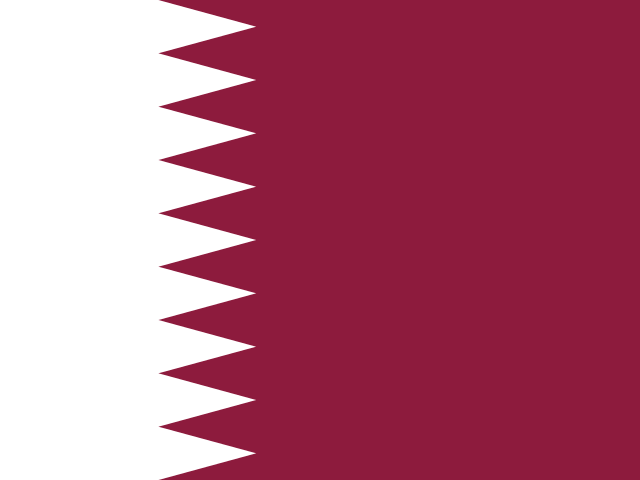
A maroon flag carries a broad, serrated white band on its left side. Maroon stands for the blood shed in Qatari wars, while white stands for peace; the nine-pointed serrated edge refers to Qatar's status as the ninth member of the "reconciled emirates" after the Qatari-British treaty of 1916. The national symbol is a white serrated band with nine white points on top of a maroon field.
Source: CIA World Factbook · 2026-02-01 · text generated from this source, approved by a person
CIA World Factbook
Values from the CIA World Factbook archive. Each carries the year it describes; open a year for the exact source field.
Natural Earth outlines · features with a Wikidata ID
Population · Natural Earth