Overview
Name
Yemen's name has an unclear origin but may come from the Arabic word "al-yamin," meaning "the right," referring to its geographic position in relation to Mecca.
Source: CIA World Factbook · 2026-02-01 · text generated from this source, approved by a person
Background
Independence from the Ottoman Empire came in 1918; the Kingdom of Yemen became the Yemen Arab Republic in 1962. The British withdrew from their protectorate around Aden in 1967; the south became the People's Republic of Southern Yemen, later renamed the People's Democratic Republic of Yemen. The states unified as the Republic of Yemen in 1990 after hostility between north and south; a secessionist movement and brief civil war in 1994 was subdued. Fighting between the government and the Houthis continued intermittently from 2004 to 2010 and again from 2014 to the present.
Protests in Sana'a spread in 2011 amid complaints about unemployment, economic conditions, and corruption; the GCC mediated Salih's transfer of power to Hadi. After Hadi's uncontested election in 2012 and the NDC's launch in 2013, the Houthis and Salih overran Sana'a in 2014, prompting Hadi's resignation in 2015. In 2015, Saudi Arabia assembled a coalition after Hadi requested intervention; UN talks in 2016 failed, while 2018 talks produced a limited cease-fire and UN mission. Parliament reconvened in 2019, fighting continued in 2020 and 2021, and a truce in 2022 preceded Hadi's replacement by a Presidential Leadership Council. Although the truce expired in 2022, large-scale conflict did not resume through 2023 as Saudi Arabia pursued roadmap talks with the Yemeni Government and Houthis.
Source: CIA World Factbook · 2026-02-01 · text generated from this source, approved by a person
Climate
Seasonal monsoons affect the western mountains, where the climate is temperate, while the west coast is hot and humid. The east has an extraordinarily hot, dry, harsh desert climate, and the country is mostly desert.
Source: CIA World Factbook · 2026-02-01 · text generated from this source, approved by a person
People and society
Its population is predominantly Arab, with Afro-Arab, South Asian, and European people also present. Arabic is the official language.
Muslims constitute virtually all of the population; virtually all Muslims are citizens, with Sunni and Shia communities both present. Other religious groups include Jewish, Baha'i, Hindu, and Christian people, many of whom are refugees or temporary foreign residents. The vast majority of the population is found in the Asir Mountains, part of the larger Sarawat Mountain system, in the far western region of the country.
Source: CIA World Factbook · 2026-02-01 · text generated from this source, approved by a person
Government
The government is in transition. Its legal system is a mixed system of Islamic (sharia) law, Napoleonic law, English common law, and customary law. The constitution was adopted by referendum 16 May 1991, following unification. The Republic of Yemen was established on 22 May 1990 through the merger of the Yemen Arab Republic and the People's Democratic Republic of Yemen, and the national holiday is Unification Day, 22 May (1990).
Source: CIA World Factbook · 2026-02-01 · text generated from this source, approved by a person
Flag and symbols
The flag has three equal horizontal bands: red at the top, followed by white and black. Black represents oppression, red represents the bloody struggle that overcomes it, and white represents the bright future that replaces it; the band colors come from the Arab Liberation flag. The national symbol is a golden eagle.
Source: CIA World Factbook · 2026-02-01 · text generated from this source, approved by a person
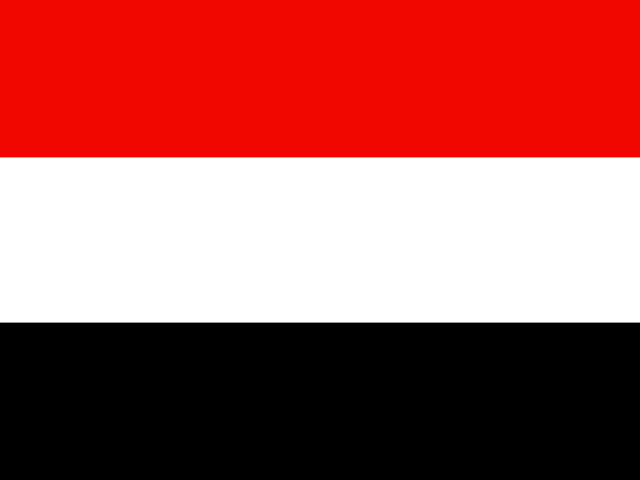 Yemen
Yemen