Name
The name probably comes from the Slavic word "pole," meaning "field" or "plain" and indicating Poland's flat nature.
Source: CIA World Factbook · 2026-02-01 · text generated from this source, approved by a person
 Poland
51.99° N, 19.49° E
For every 8.03 per 1,000 births there are 11.56 per 1,000 deaths — the population is falling 0.98% a year.
population growth -0.98% · 224th/230 · birth rate 8.03 per 1,000 · 202nd/226 · death rate 11.56 per 1,000 · 21st/226
CIA World Factbook · 2026-02-01 · ranks computed across the countries in this atlas that carry the value
geometry: Natural Earth 1:50m · EPSG:6933 equal-area
Each line is every country in this atlas that carries the value, ordered smallest to largest. The line down the middle is the world median; the mark on each line is this country.
The name probably comes from the Slavic word "pole," meaning "field" or "plain" and indicating Poland's flat nature.
Source: CIA World Factbook · 2026-02-01 · text generated from this source, approved by a person
Near the middle of the 10th century, Poland's history as a state began. By the mid-16th century, the Polish-Lithuanian Commonwealth ruled a vast tract of land in Central and Eastern Europe. During the 18th century, internal disorder weakened the nation. Between 1772 and 1795, Russia, Prussia, and Austria partitioned Poland among themselves through a series of agreements.
Poland regained its independence in 1918, but Germany and the Soviet Union overran it during World War II. After the war, Poland became a Soviet satellite state. Labor turmoil in 1980 led to the formation of Solidarity, an independent trade union that later became a political force. Free elections in 1989 and 1990 gave Solidarity control of the parliament and the presidency, bringing the communist era to a close. During the early 1990s, a 'shock therapy' program enabled Poland to transform its economy. Poland joined NATO in 1999 and the EU in 2004.
Source: CIA World Factbook · 2026-02-01 · text generated from this source, approved by a person
The country's ethnic groups include Polish, Silesian, German, and Ukrainian people, alongside others. Polish is the official language, while Silesian and other languages are also spoken.
Religious affiliations include Roman Catholic, people who refused to answer, people with no religion, Orthodox, Jehovah Witness, Evangelic of Augsburg, Greek Catholic, Pentecostal, and other Protestant communities. Other named communities include Greek Catholic, Pentecostal, and other Protestant communities. People are concentrated in the southern area around Krakow, the central area around Warsaw and Lodz, and the northern coastal city of Gdansk.
Source: CIA World Factbook · 2026-02-01 · text generated from this source, approved by a person
Its government takes the form of a parliamentary republic. The legal system is a civil law system, with judicial review of legislative, administrative, and other governmental acts; constitutional law rulings of the Constitutional Tribunal are final. The latest constitution was adopted 2 April 1997, approved by referendum 25 May 1997, and became effective 17 October 1997. Independence is dated 11 November 1918, when the republic was proclaimed. The national holiday is Constitution Day, 3 May (1791).
Source: CIA World Factbook · 2026-02-01 · text generated from this source, approved by a person
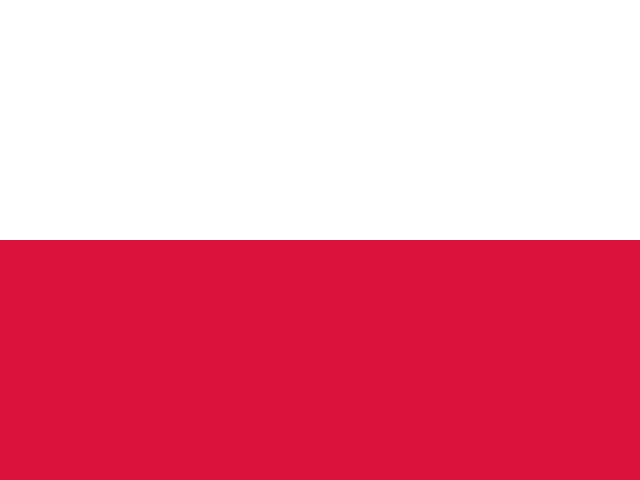
Two equal horizontal bands make up the flag: white on top and red below. These colors derive from the Polish emblem, a white eagle on a red field. The national symbol is the white crowned eagle.
Source: CIA World Factbook · 2026-02-01 · text generated from this source, approved by a person
CIA World Factbook
Values from the CIA World Factbook archive. Each carries the year it describes; open a year for the exact source field.
Natural Earth outlines · features with a Wikidata ID
Population · Natural Earth