12 cities

Location of CzechiaItalyGermanyFranceBelarusAustriaLuxembourgSwitzerlandNetherlandsSlovakiaCroatiaSloveniaBelgiumUkrainePolandLiechtensteinRomaniaHungarySerbiaCzechiaPragueOstravaPardubicePizenBrnoZlinOlomoucCeske BudejoviceLiberecHradec Kralove
Country

Czechia

Czech Republic · local name

49.88° N, 15.38° E

No coast at all — every one of its 2,046 km of border is shared with another country.

coastline 0 km · 185th/229 · land borders 2,046 km · 89th/230
CIA World Factbook · 2026-02-01 · ranks computed across the countries in this atlas that carry the value

Population
10,669,709
Area
78,867 km²
Population density
≈ 135 / km²
Capital
Prague
Natural Earth
ISO codes
CZ · CZE
GDP (nominal)
$345.04 billion
GDP per capita (PPP)
$48,000
How big, reallyDrawn at the same scale as Lithuania — the next country down in size. Equal-area projection, not the map you are used to.
Czechia 78,867 km²Lithuania 65,300 km²

geometry: Natural Earth 1:50m · EPSG:6933 equal-area

Where Czechia sits in the world

Each line is every country in this atlas that carries the value, ordered smallest to largest. The line down the middle is the world median; the mark on each line is this country.

  1. Median age44.4 years28th of 224 · median 32.6 years
  2. Life expectancy78.6 years75th of 224 · median 76.2 years
  3. Fertility rate1.73 children per woman140th of 225 · median 1.92 children per woman
  4. Population10,669,70986th of 235 · median 5,454,073
  5. Total area78,867 km²116th of 228 · median 83,736 km²
  6. Coastline0 km185th of 229 · median 402 km

Overview

Background

At the close of World War I, Czechs and Slovaks from the former Austro-Hungarian Empire merged to form Czechoslovakia, a parliamentarian democracy. During the interwar years, its predominantly Czech leaders rejected a federal system and were preoccupied with meeting increasingly strident demands from Slovaks, Sudeten Germans, and Ruthenians (Ukrainians). On the eve of World War II, Nazi Germany occupied the territory that today comprises Czechia, while Slovakia became an independent state allied with Germany. After the war, a reunited but truncated Czechoslovakia, less Ruthenia, fell within the Soviet sphere when the pro-Soviet Communist Party staged a coup in February 1948.

In 1968, an invasion by fellow Warsaw Pact troops ended efforts to liberalize communist rule and create "socialism with a human face," ushering in repression known as "normalization." At the end of 1989, the peaceful "Velvet Revolution" swept the Communist Party from power and inaugurated a return to democratic rule and a market economy. On 1 January 1993, the country underwent a nonviolent "velvet divorce" into its two national components, Czechia and Slovakia. Czechia joined NATO in 1999 and the European Union in 2004. In 2016, the country formally added Czechia as its short-form name while continuing to use its full form name.

Source: CIA World Factbook · 2026-02-01 · text generated from this source, approved by a person

Flag and symbols

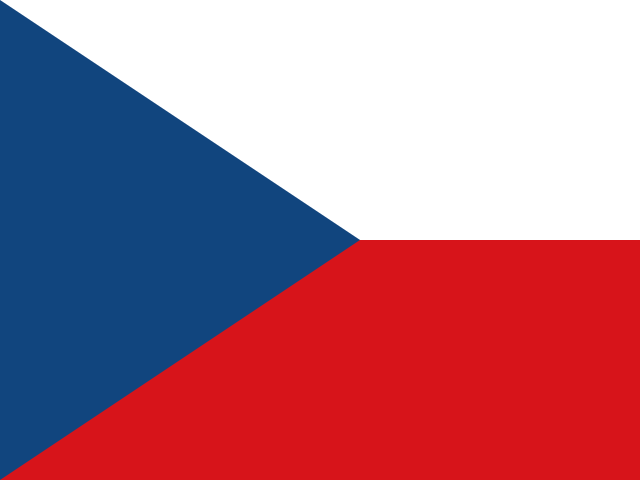
Two equal horizontal bands form the flag: white above red, with a blue isosceles triangle based on the left side. A silver (or white) double-tailed rampant lion is the national symbol.

Source: CIA World Factbook · 2026-02-01 · text generated from this source, approved by a person

Key figures

CIA World Factbook

Economy

GDP (nominal)
$345.04 billion
GDP (PPP)
$521.93 billion
GDP per capita (PPP)
$48,000
GDP growth
+1.1%
Inflation (consumer prices)
2.4%
Unemployment
2.6%
Exports
$239.26 billion
Imports
$216.74 billion

People

Life expectancy
78.6 years
Median age
44.4 years
Birth rate
9.56 per 1,000
Death rate
11.82 per 1,000
Fertility rate
1.73 children per woman
Population growth
-0.02% a year
Urban population
74.6%
Languages
  • Czechofficial88.4%
  • Slovak1.5%
  • others7.2%
Religions
  • Roman Catholic7%
  • believers unaffiliated with a religious society9.1%
  • other30.1%

Land

Total area
78,867 km²Land 77,247 km² · Water 1,620 km²
Coastline
0 km
Land borders
2,046 km
Mean elevation
433 m
Highest point
1,602 m Snezka

Values from the CIA World Factbook archive. Each carries the year it describes; open a year for the exact source field.

Connections

Natural geography 5

Natural Earth outlines · features with a Wikidata ID

Largest cities 12

Population · Natural Earth

  1. Praguecapital1.2M
  2. Ostrava479K
  3. Brno388.3K
  4. Pizen164.2K
  5. Zlin124.6K
  6. Pardubice107.1K
  7. Liberec102.2K
  8. Olomouc101.3K
  9. Ceske Budejovice98.9K
  10. Hradec Kralove95.2K
  11. Usti Nad Labem94.1K
  12. Jihlava53.9K

Sources