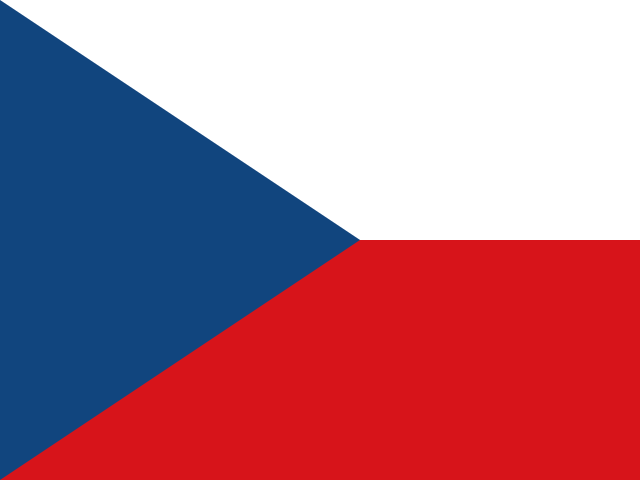
 Czechia
Background
At the close of World War I, Czechs and Slovaks from the former Austro-Hungarian Empire merged to form Czechoslovakia, a parliamentarian democracy. During the interwar years, its predominantly Czech leaders rejected a federal system and were preoccupied with meeting increasingly strident demands from Slovaks, Sudeten Germans, and Ruthenians (Ukrainians). On the eve of World War II, Nazi Germany occupied the territory that today comprises Czechia, while Slovakia became an independent state allied with Germany. After the war, a reunited but truncated Czechoslovakia, less Ruthenia, fell within the Soviet sphere when the pro-Soviet Communist Party staged a coup in February 1948.
In 1968, an invasion by fellow Warsaw Pact troops ended efforts to liberalize communist rule and create "socialism with a human face," ushering in repression known as "normalization." At the end of 1989, the peaceful "Velvet Revolution" swept the Communist Party from power and inaugurated a return to democratic rule and a market economy. On 1 January 1993, the country underwent a nonviolent "velvet divorce" into its two national components, Czechia and Slovakia. Czechia joined NATO in 1999 and the European Union in 2004. In 2016, the country formally added Czechia as its short-form name while continuing to use its full form name.
Source: CIA World Factbook · 2026-02-01 · text generated from this source, approved by a person