5 cities

Location of LithuaniaSwedenBelarusDenmarkLatviaEstoniaUkrainePolandLithuaniaKaunasSiauliaiKlaipedaPanevezysVilnius
Country

Lithuania

55.10° N, 24.09° E

For every 7.01 per 1,000 births there are 14.1 per 1,000 deaths — the population is falling 0.71% a year.

population growth -0.71% · 219th/230 · birth rate 7.01 per 1,000 · 219th/226 · death rate 14.1 per 1,000 · 7th/226
CIA World Factbook · 2026-02-01 · ranks computed across the countries in this atlas that carry the value

Population
2,786,844
Area
65,300 km²
Population density
≈ 43 / km²
Capital
Vilnius
Natural Earth
ISO codes
LT · LTU
GDP (nominal)
$84.87 billion
GDP per capita (PPP)
$47,200
How big, reallyDrawn at the same scale as Bosnia and Herzegovina — the next country down in size. Equal-area projection, not the map you are used to.
Lithuania 65,300 km²Bosnia and Herzegovina 51,197 km²

geometry: Natural Earth 1:50m · EPSG:6933 equal-area

Where Lithuania sits in the world

Each line is every country in this atlas that carries the value, ordered smallest to largest. The line down the middle is the world median; the mark on each line is this country.

  1. Median age44 years32nd of 224 · median 32.6 years
  2. Life expectancy76.1 years113th of 224 · median 76.2 years
  3. Fertility rate1.22 children per woman217th of 225 · median 1.92 children per woman
  4. Population2,786,844142nd of 235 · median 5,454,073
  5. Total area65,300 km²123rd of 228 · median 83,736 km²
  6. Coastline90 km160th of 229 · median 402 km

Overview

Background

Lithuanian lands were united under Mindaugas in 1236, and alliances and conquest then expanded the realm into most of present-day Belarus and Ukraine. By the end of the 14th century, Lithuania was the largest state in Europe. An alliance with Poland in 1386 brought the two countries into a union through a common ruler. In 1569, Lithuania and Poland formally united into the single dual state called the Polish-Lithuanian Commonwealth. This entity survived until 1795, when surrounding countries partitioned its remnants.

Lithuania regained its independence after World War I, but the USSR annexed it in 1940, an action never recognized by the US and many other countries. In 1990, Lithuania became the first of the Soviet republics to declare its independence, but Moscow did not recognize this proclamation until 1991. The last Russian troops withdrew in 1993. Lithuania subsequently restructured its economy for integration into West European institutions, joining both NATO and the EU in 2004. In 2015, Lithuania joined the euro zone, and it joined the Organization for Economic Cooperation and Development in 2018.

Source: CIA World Factbook · 2026-02-01 · text generated from this source, approved by a person

Government

A semi-presidential republic defines the form of government. Its civil law system allows legislative acts to be appealed to the Constitutional Court. The latest constitution was adopted by referendum 25 October 1992 and entered into force 2 November 1992. Its independence dates are 16 February 1918 from Soviet Russia and Germany, 11 March 1990 declared from the Soviet Union, and 6 September 1991 recognized by the Soviet Union. The national holiday is Independence Day (or National Day), 16 February (1918).

Source: CIA World Factbook · 2026-02-01 · text generated from this source, approved by a person

Flag and symbols

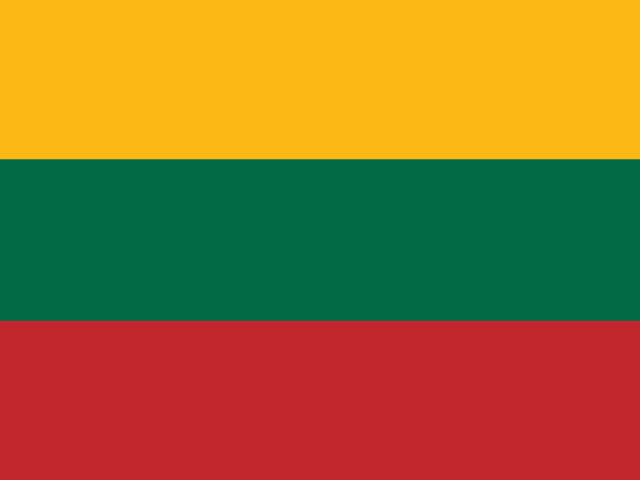
Three equal horizontal bands—yellow at the top, green, and red—form Lithuania’s flag. Yellow stands for golden fields, the sun, light, and goodness; green for the forests, nature, freedom, and hope; red for courage and the blood spilled in defense of the homeland. Its national symbols are the mounted knight known as Vytis (the Chaser) and the white stork.

Source: CIA World Factbook · 2026-02-01 · text generated from this source, approved by a person

Key figures

CIA World Factbook

Economy

GDP (nominal)
$84.87 billion
GDP (PPP)
$136.23 billion
GDP per capita (PPP)
$47,200
GDP growth
+2.8%
Inflation (consumer prices)
0.7%
Unemployment
7.6%
Exports
$62.9 billion
Imports
$58.49 billion

People

Life expectancy
76.1 years
Median age
44 years
Birth rate
7.01 per 1,000
Death rate
14.1 per 1,000
Fertility rate
1.22 children per woman
Population growth
-0.71% a year
Urban population
68.7%
Languages
  • Lithuanianofficial85.3%
  • Russian6.8%
  • Polish5.1%
  • two mother tongues1.7%
  • others1.1%
Religions
  • Roman Catholic74.2%
  • Russian Orthodox3.7%
  • Old Believer0.6%
  • Evangelical Lutheran0.6%
  • Evangelical Reformist0.2%
  • other13.7%

Land

Total area
65,300 km²Land 62,680 km² · Water 2,620 km²
Coastline
90 km
Land borders
1,545 km
Mean elevation
110 m
Highest point
294 m Aukstojas

Values from the CIA World Factbook archive. Each carries the year it describes; open a year for the exact source field.

Connections

Natural geography 1

Natural Earth outlines · features with a Wikidata ID

Largest cities 5

Population · Natural Earth

  1. Vilniuscapital542.4K
  2. Kaunas374.6K
  3. Klaipeda192.3K
  4. Siauliai133.5K
  5. Panevezys127.4K

Sources