Overview
Name
The name "Latvia" originates from the "Latgalians," one of four eastern Baltic tribes that formed the ethnic core of the Latvian people around the 8th through 12th centuries CE.
Source: CIA World Factbook · 2026-02-01 · text generated from this source, approved by a person
Geography
Between Estonia and Lithuania, Latvia borders the Baltic Sea in Eastern Europe. Its terrain is a low plain. Fertile low-lying plains compose most of the country, with some hills in the east.
Peat, limestone, dolomite, amber, hydropower, timber, and arable land are among its natural resources. Gaizina Kalns is the highest point. The Baltic Sea is the lowest point.
Source: CIA World Factbook · 2026-02-01 · text generated from this source, approved by a person
People and society
The largest concentration of people is found in and around Riga, the port and capital city, while small agglomerations are scattered throughout the country. Latvian, Russian, Belarusian, Ukrainian, Polish, and Lithuanian people live alongside others.
Latvian is the official language, alongside Russian and other languages including Polish, Ukrainian, and Belarusian. Religious identities include Lutheran, Roman Catholic, Orthodox, and other Christian affiliations, as well as other affiliations or none.
Source: CIA World Factbook · 2026-02-01 · text generated from this source, approved by a person
Government
A parliamentary republic, Latvia uses a civil law system with traces of socialist legal traditions and practices. After independence was restored in 1991, parts of the 1922 constitution were reintroduced on 4 May 1990 and fully reintroduced on 6 July 1993. Its independence dates are 18 November 1918 (from Soviet Russia), 4 May 1990 (declared from the Soviet Union), and 6 September 1991 (recognized by the Soviet Union). The national holiday is Independence Day (Republic of Latvia Proclamation Day), 18 November (1918).
Source: CIA World Factbook · 2026-02-01 · text generated from this source, approved by a person
Flag and symbols
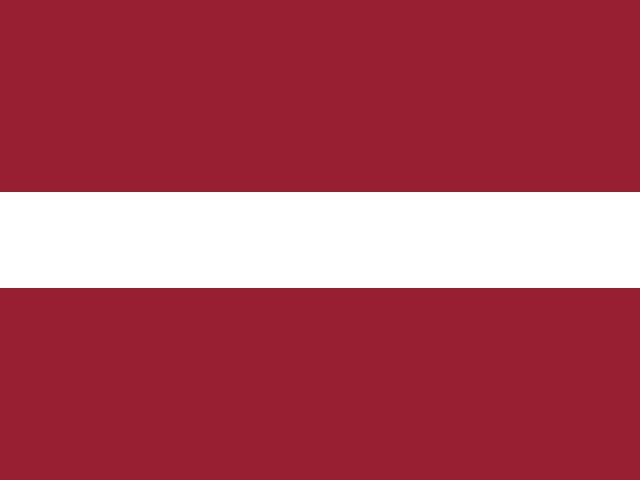
Three horizontal bands form the flag: maroon at the top, white in the center, and maroon at the bottom. A medieval chronicle mentions Latvian tribes using a red standard with a white stripe around 1280, and the flag is one of the older banners in the world. The white wagtail is the national symbol.
Source: CIA World Factbook · 2026-02-01 · text generated from this source, approved by a person
 Latvia