Name
The name Kenya comes from Mount Kenya; the mountain's name may derive from the Kikuyu word "kere nyaga", or "white mountain".
Source: CIA World Factbook · 2026-02-01 · text generated from this source, approved by a person
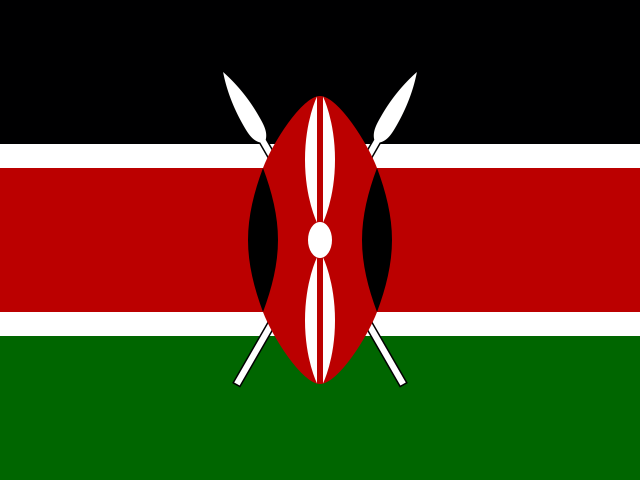 Kenya
Kenya0.55° N, 37.91° E
3,457 km of land border against just 536 km of coast — this country faces its neighbors far more than it faces the sea.
coastline 536 km · 101st/229 · land borders 3,457 km · 60th/230
CIA World Factbook · 2026-02-01 · ranks computed across the countries in this atlas that carry the value
geometry: Natural Earth 1:50m · EPSG:6933 equal-area
Each line is every country in this atlas that carries the value, ordered smallest to largest. The line down the middle is the world median; the mark on each line is this country.
The name Kenya comes from Mount Kenya; the mountain's name may derive from the Kikuyu word "kere nyaga", or "white mountain".
Source: CIA World Factbook · 2026-02-01 · text generated from this source, approved by a person
By around the 9th century, Africans, Arabs, and Persians on the Land of Zanj coast were known as Swahili, with KiSwahili and a distinct culture. Portuguese forces arrived in the 1490s and were pushed out by Oman and Pate in the late 1600s. In 1890, Germany and the UK divided the region; Britain established the East Africa Protectorate in 1895 and converted it into a colony in 1920. Political disputes led to the Mau Mau Uprising in 1952 and independence in 1963.
Jomo Kenyatta led Kenya from independence until his death in 1978, when Vice President Daniel Arap Moi took power through constitutional succession. Kenya was a de facto one-party state from 1969 until 1982; Moi allowed political liberalization in 1991. KANU retained power in 1992 and 1997, but Moi stepped down in 2002 after fair, peaceful elections, bringing Mwai Kibaki to the presidency. Raila Odinga's 2007 challenge led to ethnic violence; African Union mediation made him prime minister, and the 2010 constitution removed that office and devolved power. Uhuru Kenyatta won elections in 2013 and 2017; William Ruto won in 2022 and assumed office the following month after the Supreme Court upheld his victory.
Source: CIA World Factbook · 2026-02-01 · text generated from this source, approved by a person
Along the coast, conditions are tropical, while the interior is arid. Recurring drought and flooding during rainy seasons are climate hazards.
Source: CIA World Factbook · 2026-02-01 · text generated from this source, approved by a person
A mixed system of English common law, Islamic law, and customary law forms the legal system; the Supreme Court reviews laws. The government is a presidential republic. The current constitution was passed by referendum on 4 August 2010. Kenya became independent from the UK on 12 December 1963. Jamhuri Day (Independence Day) is the national holiday on 12 December (1963).
Source: CIA World Factbook · 2026-02-01 · text generated from this source, approved by a person
CIA World Factbook
Values from the CIA World Factbook archive. Each carries the year it describes; open a year for the exact source field.
Natural Earth outlines · features with a Wikidata ID
Population · Natural Earth