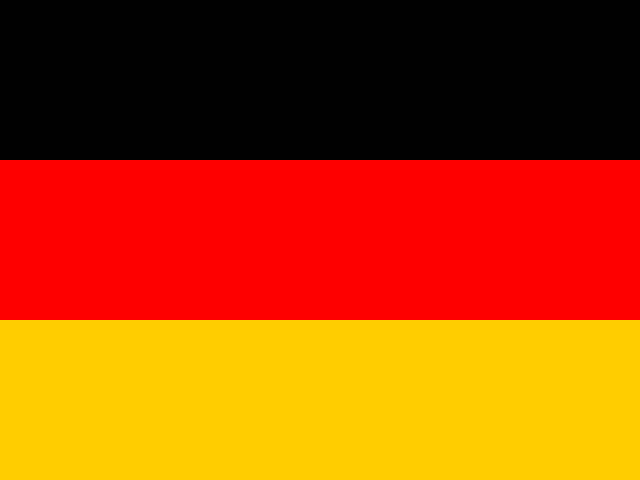
58 cities

Location of GermanySpainItalyGuernseyÅlandVaticanNorth MacedoniaGreeceSwedenBosnia and HerzegovinaFaroe IslandsUnited KingdomKosovoNorwayFinlandIsle of ManMoldovaJerseyAndorraFranceSan MarinoMonacoTürkiyeBelarusMontenegroAustriaLuxembourgSwitzerlandBulgariaDenmarkNetherlandsLatviaLithuaniaAlbaniaSlovakiaCroatiaSloveniaEstoniaBelgiumPortugalUkrainePolandLiechtensteinRomaniaIrelandCzechiaHungarySerbiaGermanyBerlinMunichStuttgartFrankfurtMannheimHamburgEssenDusseldorfCologneDuisburg
Country

Germany

50.96° N, 9.68° E

For every 8.87 per 1,000 births there are 11.96 per 1,000 deaths — the population is falling 0.13% a year.

population growth -0.13% · 196th/230 · birth rate 8.87 per 1,000 · 190th/226 · death rate 11.96 per 1,000 · 17th/226
CIA World Factbook · 2026-02-01 · ranks computed across the countries in this atlas that carry the value

Population
83,132,799
Area
357,022 km²
Population density
≈ 233 / km²
Capital
Berlin
Natural Earth
ISO codes
DE · DEU
GDP (nominal)
$4.66 trillion
GDP per capita (PPP)
$62,800
How big, reallyDrawn at the same scale as Ecuador. Equal-area projection, not the map you are used to.
Germany 357,022 km²Ecuador 283,561 km²

geometry: Natural Earth 1:50m · EPSG:6933 equal-area

Where Germany sits in the world

Each line is every country in this atlas that carries the value, ordered smallest to largest. The line down the middle is the world median; the mark on each line is this country.

  1. Median age46.9 years10th of 224 · median 32.6 years
  2. Life expectancy81.9 years37th of 224 · median 76.2 years
  3. Fertility rate1.59 children per woman169th of 225 · median 1.92 children per woman
  4. Population83,132,79918th of 235 · median 5,454,073
  5. Total area357,022 km²63rd of 228 · median 83,736 km²
  6. Coastline2,389 km54th of 229 · median 402 km

Overview

People and society

German is the official language, while Danish, Frisian, Sorbian, and Romani are official minority languages.

Low German, Danish, North Frisian, Sater Frisian, Lower Sorbian, Upper Sorbian, and Romani are recognized as regional languages. The population includes the ethnic groups German, Turkish, Ukrainian, Syrian, Romanian, and Poland. Roman Catholic, Protestant, Muslim, other religions, and no religion are all represented among the population. People are fairly evenly distributed through most of the country, while urban areas attract larger and denser populations, particularly in the far-western part of the industrial state of North Rhine-Westphalia.

Source: CIA World Factbook · 2026-02-01 · text generated from this source, approved by a person

Key figures

CIA World Factbook

Economy

GDP (nominal)
$4.66 trillion
GDP (PPP)
$5.25 trillion
GDP per capita (PPP)
$62,800
GDP growth
-0.2%
Inflation (consumer prices)
2.3%
Unemployment
3.5%
Exports
$1.95 trillion
Imports
$1.77 trillion

People

Life expectancy
81.9 years
Median age
46.9 years
Birth rate
8.87 per 1,000
Death rate
11.96 per 1,000
Fertility rate
1.59 children per woman
Population growth
-0.13% a year
Urban population
77.8%
Languages
  • Germanofficial
  • note - Danish
  • Frisian
  • Sorbian
  • and Romani are official minority languages
  • Low German
  • Danish
  • North Frisian
  • Sater Frisian
  • Lower Sorbian
  • Upper Sorbian
  • and Romani are recognized as regional languages
Religions
  • Roman Catholic24.8%
  • Protestant22.6%
  • Muslim3.7%
  • other43.8%

Land

Total area
357,022 km²Land 348,672 km² · Water 8,350 km²
Coastline
2,389 km
Land borders
3,694 km
Mean elevation
263 m
Highest point
2,963 m Zugspitze

Values from the CIA World Factbook archive. Each carries the year it describes; open a year for the exact source field.

Connections

Natural geography 13

Natural Earth outlines · features with a Wikidata ID

Geographic regions 1

Largest cities 58

Population · Natural Earth

  1. Berlincapital3.4M
  2. Stuttgart2.9M
  3. Frankfurt2.9M
  4. Mannheim2.4M
  5. Hamburg1.8M
  6. Essen1.7M
  7. Duisburg1.3M
  8. Munich1.3M
  9. Dusseldorf1.2M
  10. Cologne1M
  11. Wuppertal776.5K
  12. Saarbrucken770K

Sources