Climate
Snowy, cold winters and warm, dry summers define a temperate climate.
Source: CIA World Factbook · 2026-02-01 · text generated from this source, approved by a person
 Andorra
42.55° N, 1.54° E
Half of everyone here is over 49 — only 3 countries in the world are older.
median age 49.4 years · 4th/224
CIA World Factbook · 2026-02-01 · ranks computed across the countries in this atlas that carry the value
geometry: Natural Earth 1:50m · EPSG:6933 equal-area
Each line is every country in this atlas that carries the value, ordered smallest to largest. The line down the middle is the world median; the mark on each line is this country.
Snowy, cold winters and warm, dry summers define a temperate climate.
Source: CIA World Factbook · 2026-02-01 · text generated from this source, approved by a person
The population is concentrated in seven urbanized valleys that make up the country's parishes, its political administrative divisions. Its people include Spanish, Andorran, Portuguese, French, and others.
Religious affiliations are Christian, predominantly Roman Catholic, alongside other religions and unaffiliated people.
Source: CIA World Factbook · 2026-02-01 · text generated from this source, approved by a person
With a parliamentary democracy since March 1993, Andorra retains its chiefs of state as a co-principality: the two princes are the President of France and Bishop of Seu d'Urgell, Spain. Its legal system is mixed, combining civil and customary law with the influence of canon (religious) law. The constitution was drafted 1991, approved by referendum 14 March 1993, and effective 28 April 1993. Independence dates to 1278, when Andorra formed under the joint sovereignty of the French Count of Foix and the Spanish Bishop of Urgell. Our Lady of Meritxell Day, 8 September (1278), is the national holiday.
Source: CIA World Factbook · 2026-02-01 · text generated from this source, approved by a person
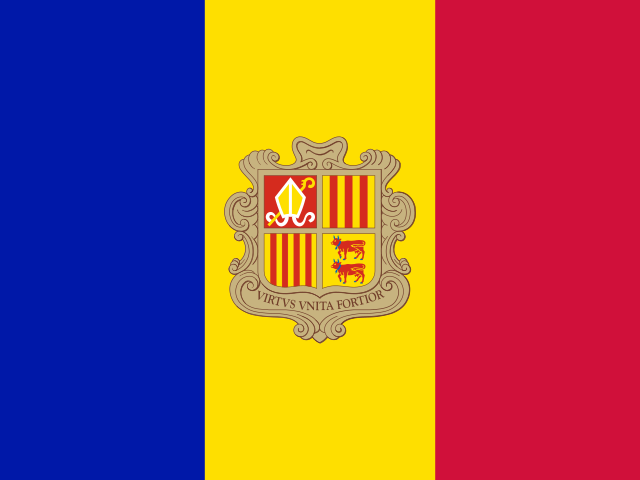
Three vertical bands—blue, yellow, and red—form the flag; yellow is slightly wider and centers the coat of arms. The coat of arms features a quartered shield with emblems of Urgell, Foix, Bearn, and Catalonia. The motto reads "VIRTUS UNITA FORTIOR" (Strength United is Stronger), meaning the flag combines the blue and red French colors with the red and yellow of Spain to symbolize Franco-Spanish protection. The red cow is a national symbol.
Source: CIA World Factbook · 2026-02-01 · text generated from this source, approved by a person
CIA World Factbook
Values from the CIA World Factbook archive. Each carries the year it describes; open a year for the exact source field.
Natural Earth outlines · features with a Wikidata ID
Population · Natural Earth