42 cities

Location of VenezuelaColombiaCayman IslandsSint MaartenBritish Virgin IslandsSaint Kitts and NevisTurks and Caicos IslandsBarbadosSaint BarthélemyDominican RepublicSaint Vincent and the GrenadinesAntigua and BarbudaPeruAnguillaUnited States Virgin IslandsTrinidad and TobagoPanamaGuatemalaGuyanaHaitiHondurasFranceCuraçaoArubaPuerto RicoSaint LuciaBrazilBelizeMontserratGrenadaEl SalvadorDominicaMexicoNetherlandsSaint MartinJamaicaEcuadorBoliviaCubaSurinameBahamasNicaraguaCosta RicaVenezuelaCaracasMaracaiboCabimasValenciaMaracayBarcelonaPuerto la CruzSan CristobalBarquisimetoCiudad Guayana
Country

Venezuela

7.18° N, 64.60° W

Population
28,515,829
Area
912,050 km²
Population density
≈ 31 / km²
Capital
Caracas
Natural Earth
ISO codes
VE · VEN
GDP (nominal)
$139.4 billion
GDP per capita (PPP)
$4,900
How big, reallyDrawn at the same scale as Zambia — the next country down in size. Equal-area projection, not the map you are used to.
Venezuela 912,050 km²Zambia 752,618 km²

geometry: Natural Earth 1:50m · EPSG:6933 equal-area

Where Venezuela sits in the world

Each line is every country in this atlas that carries the value, ordered smallest to largest. The line down the middle is the world median; the mark on each line is this country.

  1. Median age31.3 years124th of 224 · median 32.6 years
  2. Life expectancy74.5 years138th of 224 · median 76.2 years
  3. Fertility rate2.16 children per woman87th of 225 · median 1.92 children per woman
  4. Population28,515,82950th of 235 · median 5,454,073
  5. Total area912,050 km²34th of 228 · median 83,736 km²
  6. Coastline2,800 km41st of 229 · median 402 km

Overview

Name

In 1499, stilt-houses built on Lake Maracaibo reminded explorers Alonso de Ojeda and Amerigo Vespucci of buildings in Venice, Italy. They named the region "Venezuola," meaning "Little Venice".

Source: CIA World Factbook · 2026-02-01 · text generated from this source, approved by a person

Background

Venezuela emerged from Gran Colombia's collapse in 1830, alongside Ecuador and New Granada (Colombia). Military strongmen ruled for most of the first half of the 20th century, promoting oil and allowing social reforms. Elected governments largely held sway until 1999, when Hugo Chavez, president from 1999 to 2013, exercised authoritarian control over other branches of government. In 2018, Nicolas Maduro claimed the presidency for his second term in an election boycotted by most opposition parties and widely viewed as fraudulent. The 2020 legislative elections were also seen as fraudulent, and most opposition parties and many international actors considered the resulting National Assembly illegitimate.

Many opposition parties broke a three-year election boycott in 2021 and participated in mayoral and gubernatorial elections despite flawed conditions. Since Chavez, the ruling party expanded economic control through expropriations, currency and price controls, and petroleum dependence; after years of mismanagement, the 2014 oil-price drop brought decline, shortages, and high inflation. The US imposed financial sanctions on Maduro and his representatives in 2017 and on sectors of Venezuela's economy in 2018; limited relief followed after democratic and electoral concessions. Ongoing concerns include human rights abuses, rampant violent crime, political manipulation of judicial and electoral systems, and corruption.

Source: CIA World Factbook · 2026-02-01 · text generated from this source, approved by a person

Climate

Tropical conditions bring heat and humidity, while the highlands have a more moderate climate.

Source: CIA World Factbook · 2026-02-01 · text generated from this source, approved by a person

People and society

Its people include Spanish, Italian, Portuguese, Arab, German, African, and Indigenous backgrounds. Spanish is the official language, alongside indigenous, Portuguese, and other languages.

Religions include Roman Catholic, Protestant, Jehovah's Witness, and African American/umbanda; Protestant affiliations include Evangelical and Adventist. Religious identifications also include believer, agnostic, atheist, and none. People are concentrated in the northern and western highlands along an eastern spur at the northern end of the Andes, an area that includes the capital of Caracas.

Source: CIA World Factbook · 2026-02-01 · text generated from this source, approved by a person
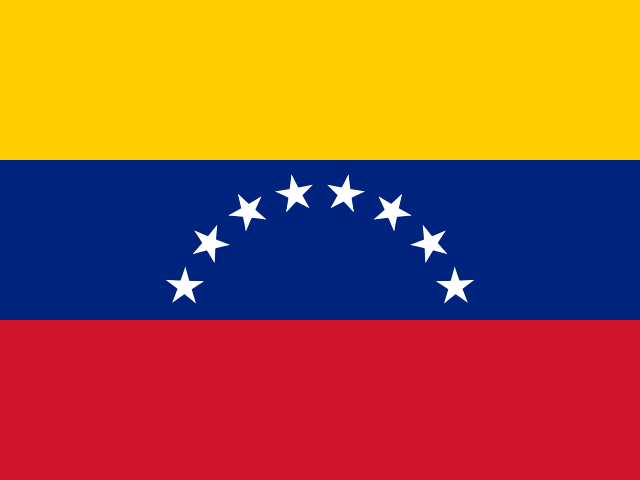
Key figures

CIA World Factbook

Economy

GDP (nominal)
$139.4 billion
GDP (PPP)
$110.94 billion
GDP per capita (PPP)
$4,900
GDP growth
-19.7%
Inflation (consumer prices)
200.9%
Unemployment
5.5%
Exports
$83.4 billion
Imports
$18.43 billion

People

Life expectancy
74.5 years
Median age
31.3 years
Birth rate
16.45 per 1,000
Death rate
6.54 per 1,000
Fertility rate
2.16 children per woman
Population growth
+0.88% a year
Urban population
88.4%
Literacy
97.2%
Languages
  • Spanishofficial98.2%
  • indigenous1.3%
  • Portuguese0.1%
  • others0.4%

Land

Total area
912,050 km²Land 882,050 km² · Water 30,000 km²
Coastline
2,800 km
Land borders
5,267 km
Mean elevation
450 m
Highest point
4,978 m Pico Bolivar

Values from the CIA World Factbook archive. Each carries the year it describes; open a year for the exact source field.

Connections

Natural geography 9

Natural Earth outlines · features with a Wikidata ID

Largest cities 42

Population · Natural Earth

  1. Caracascapital3M
  2. Maracaibo2.1M
  3. Valencia1.8M
  4. Barquisimeto1.1M
  5. Maracay1M
  6. Ciudad Guayana746.5K
  7. Barcelona601K
  8. Puerto la Cruz546.6K
  9. Cabimas441.1K
  10. San Cristobal438.8K
  11. Maturin411K
  12. Merida345.5K

Sources