Name
The name Türkiye means "Land of the Turks".
Source: CIA World Factbook · 2026-02-01 · text generated from this source, approved by a person
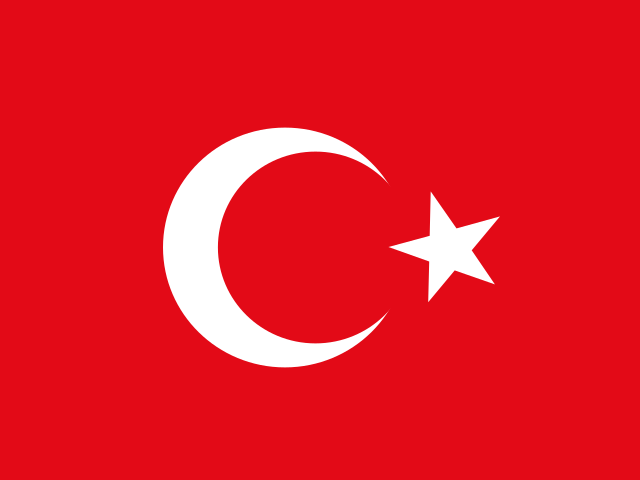 Türkiye
39.35° N, 34.51° E
7,200 km of coast against 2,816 km of land border — this country faces the sea far more than it faces its neighbors.
coastline 7,200 km · 19th/229 · land borders 2,816 km · 69th/230
CIA World Factbook · 2026-02-01 · ranks computed across the countries in this atlas that carry the value
geometry: Natural Earth 1:50m · EPSG:6933 equal-area
Each line is every country in this atlas that carries the value, ordered smallest to largest. The line down the middle is the world median; the mark on each line is this country.
The name Türkiye means "Land of the Turks".
Source: CIA World Factbook · 2026-02-01 · text generated from this source, approved by a person
The Turkish Straits—Bosporus, Sea of Marmara, and Dardanelles—link the Black Sea and the Aegean Sea. Türkiye lies in Southeastern Europe and Southwestern Asia, with the portion of Türkiye west of the Bosporus geographically part of Europe. It borders the Black Sea between Bulgaria and Georgia, and the Aegean Sea and Mediterranean Sea between Greece and Syria.
Its terrain includes a high central plateau in Anatolia, a narrow coastal plain, and several mountain ranges. Natural resources include coal, iron ore, copper, chromium, gold, limestone, marble, arable land, and hydropower. Mount Ararat lies in the far-eastern part of the country and is reputed to be the landing place of Noah's ark.
Source: CIA World Factbook · 2026-02-01 · text generated from this source, approved by a person
A temperate climate brings hot, dry summers and mild, wet winters to Türkiye. The interior has harsher conditions.
Source: CIA World Factbook · 2026-02-01 · text generated from this source, approved by a person
Around the Bosporus in the northwest, Türkiye has its most densely populated area, including Istanbul. With the exception of Ankara, urban centers remain small and scattered throughout the interior of Anatolia. An overall pattern of peripheral development exists particularly along the Aegean Sea coast in the west and the Tigris and Euphrates River systems in the southeast.
Türkiye's people include Turkish, Kurdish, and other minority groups. Turkish is the official language, while people also speak Kurdish and other minority languages. Muslims, mostly Sunni, and Christians and Jews are represented among Türkiye's religions.
Source: CIA World Factbook · 2026-02-01 · text generated from this source, approved by a person
CIA World Factbook
Values from the CIA World Factbook archive. Each carries the year it describes; open a year for the exact source field.
Natural Earth outlines · features with a Wikidata ID
Population · Natural Earth
Area computed from boundaries · neighbors from shared borders