Geography
A rugged, mountainous rim and a high, central basin with deserts and mountains mark the terrain. Small, discontinuous plains extend along both coasts. In the Middle East, Iran borders the Gulf of Oman, the Persian Gulf, and the Caspian Sea, between Iraq and Pakistan.
Iran has a strategic location on the Persian Gulf and Strait of Hormuz. Its natural resources include petroleum, natural gas, coal, chromium, copper, iron ore, lead, manganese, zinc, and sulfur. Kuh-e Damavand is the highest point. The Caspian Sea is the lowest point.
Source: CIA World Factbook · 2026-02-01 · text generated from this source, approved by a person
People and society
Its ethnic groups include Persian, Azeri, Kurd, Lur, Baloch, Arab, Turkmen, and Turkic tribes. Persian Farsi is the official language, alongside Azeri and other Turkic dialects, Kurdish, Gilaki and Mazandarani, Luri, Balochi, and Arabic.
Muslim is the official religion, alongside Christian, Baha'i, and agnostic affiliations. Other affiliations include Zoroastrian, Jewish, and Hindu. Population is concentrated in the north, northwest, and west, reflecting the position of the Zagros and Elburz Mountains. The vast, dry center and east, around the Dasht-e Kavir and Dasht-e Lut deserts, have much lower population density.
Source: CIA World Factbook · 2026-02-01 · text generated from this source, approved by a person
Flag and symbols
Three equal horizontal bands of green, white, and red form the flag. The white band centers a red emblem stylizing Allah as a tulip, a symbol of martyrdom. White Arabic script repeats ALLAH AKBAR at the green band's bottom and red band's top. Green is the color of Islam and represents growth; white stands for honesty and peace, and red for bravery and martyrdom. The national symbol is the lion.
Source: CIA World Factbook · 2026-02-01 · text generated from this source, approved by a person
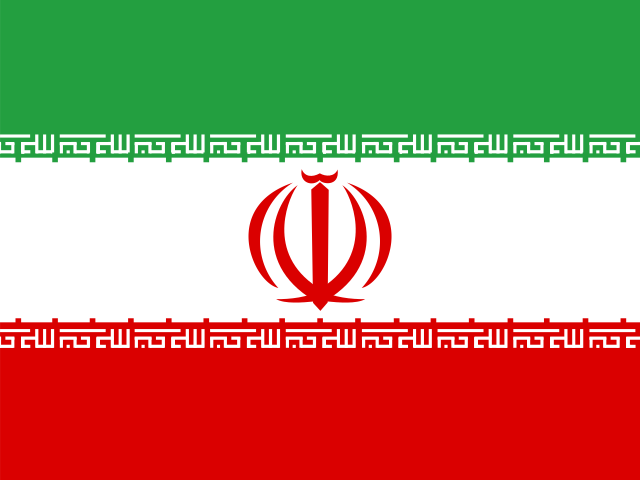 Iran
Iran