2 cities

Location of Trinidad and TobagoVenezuelaGrenadaTrinidad and TobagoPort-of-SpainSan Fernando
Country

Trinidad and Tobago

10.43° N, 61.25° W

No land border at all — every neighbor is across water, along 362 km of coast, the 122nd longest on Earth.

land borders 0 km · 164th/230 · coastline 362 km · 122nd/229
CIA World Factbook · 2026-02-01 · ranks computed across the countries in this atlas that carry the value

Population
1,394,973
Area
5,128 km²
Population density
≈ 274 / km²
Capital
Port-of-Spain
Natural Earth
ISO codes
TT · TTO
GDP (nominal)
$26.43 billion
GDP per capita (PPP)
$31,700
How big, reallyDrawn at the same scale as Cabo Verde — the next country down in size. Equal-area projection, not the map you are used to.
Trinidad and Tobago 5,128 km²Cabo Verde 4,033 km²

geometry: Natural Earth 1:50m · EPSG:6933 equal-area

Where Trinidad and Tobago sits in the world

Each line is every country in this atlas that carries the value, ordered smallest to largest. The line down the middle is the world median; the mark on each line is this country.

  1. Median age39.1 years71st of 224 · median 32.6 years
  2. Life expectancy76.5 years106th of 224 · median 76.2 years
  3. Fertility rate1.63 children per woman160th of 225 · median 1.92 children per woman
  4. Population1,394,973155th of 235 · median 5,454,073
  5. Total area5,128 km²171st of 228 · median 83,736 km²
  6. Coastline362 km122nd of 229 · median 402 km

Overview

Name

Christopher Columbus named the larger island "La Isla de la Trinidad" ("The Island of the Trinity"), possibly for its three mountain peaks. For Tobago, Columbus may have taken the name, spelled "tobaco" in Spanish, from tobacco grown and smoked locally or from its elongated cigar shape.

Source: CIA World Factbook · 2026-02-01 · text generated from this source, approved by a person

Background

First colonized by the Spanish, Trinidad and Tobago came under British control in the early 19th century. The emancipation of enslaved people in 1834 disrupted the twin islands' sugar industry. Contract workers arriving from India between 1845 and 1917 augmented the labor force, boosting sugar production as well as the cocoa industry. The discovery of oil on Trinidad in 1910 added another important export that remains the country's dominant industry.

Trinidad and Tobago attained independence in 1962. The country is one of the most prosperous in the Caribbean, thanks largely to petroleum and natural gas production and processing. The government is struggling to reverse a surge in violent crime.

Source: CIA World Factbook · 2026-02-01 · text generated from this source, approved by a person

People and society

The population includes East Indian, African descent, mixed - other, and mixed - African/East Indian groups, as well as others. Religious affiliations include Protestant, Roman Catholic, Hindu, Muslim, Jehovah's Witness, other affiliations, and none. Among Protestants are Pentecostal/Evangelical/Full Gospel, Baptist, Anglican, Seventh Day Adventist, Presbyterian/Congregational, and other Protestant congregations.

On Trinidad, population is concentrated in the western half of the island, while on Tobago it is concentrated in the southern half.

Source: CIA World Factbook · 2026-02-01 · text generated from this source, approved by a person

Flag and symbols

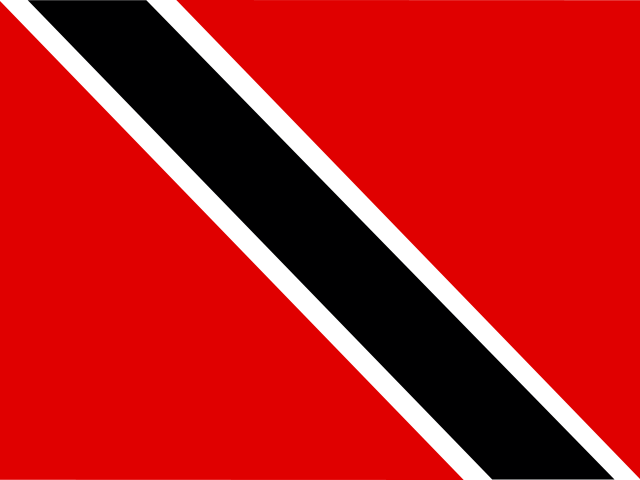
A red flag has a white-edged black diagonal band from upper left to lower right. Its colors represent the elements of earth, water, and fire; black also stands for the land's wealth and people's dedication. White stands for the sea, purity of the country's aspirations, equality; red stands for the sun, land vitality, people's courage and friendliness. National symbols are the scarlet ibis, bird of Trinidad; cocrico, bird of Tobago; and chaconia flower.

Source: CIA World Factbook · 2026-02-01 · text generated from this source, approved by a person
Key figures

CIA World Factbook

Economy

GDP (nominal)
$26.43 billion
GDP (PPP)
$43.36 billion
GDP per capita (PPP)
$31,700
GDP growth
+1.7%
Inflation (consumer prices)
0.5%
Unemployment
4.6%
Exports
$11.09 billion
Imports
$10.19 billion

People

Life expectancy
76.5 years
Median age
39.1 years
Birth rate
10.33 per 1,000
Death rate
8.69 per 1,000
Fertility rate
1.63 children per woman
Population growth
+0.08% a year
Urban population
53.4%
Languages
  • Englishofficial
  • Trinidadian Creole English
  • Tobagonian Creole English
  • Caribbean Hindustani
  • Trinidadian Creole French
  • Spanish
  • Chinese
Religions
  • Protestant32.1%Pentecostal/Evangelical/Full Gospel 12%, Baptist 6.9%, Anglican 5.7%, Seventh Day Adventist 4.1%, Presbyterian/Congregational 2.5%, other Protestant 0.9%
  • Roman Catholic21.6%
  • Hindu18.2%
  • Muslim5%
  • Jehovah's Witness1.5%
  • other11.1%

Land

Total area
5,128 km²Land 5,128 km² · Water 0 km²
Coastline
362 km
Land borders
0 km
Mean elevation
83 m
Highest point
940 m El Cerro del Aripo

Values from the CIA World Factbook archive. Each carries the year it describes; open a year for the exact source field.

Connections

Natural geography 4

Natural Earth outlines · features with a Wikidata ID

Islands 1

Largest cities 2

Population · Natural Earth

  1. Port-of-Spaincapital294.9K
  2. San Fernando166K

Sources