Overview
Name
Christopher Columbus named the larger island "La Isla de la Trinidad" ("The Island of the Trinity"), possibly for its three mountain peaks. For Tobago, Columbus may have taken the name, spelled "tobaco" in Spanish, from tobacco grown and smoked locally or from its elongated cigar shape.
Source: CIA World Factbook · 2026-02-01 · text generated from this source, approved by a person
Background
First colonized by the Spanish, Trinidad and Tobago came under British control in the early 19th century. The emancipation of enslaved people in 1834 disrupted the twin islands' sugar industry. Contract workers arriving from India between 1845 and 1917 augmented the labor force, boosting sugar production as well as the cocoa industry. The discovery of oil on Trinidad in 1910 added another important export that remains the country's dominant industry.
Trinidad and Tobago attained independence in 1962. The country is one of the most prosperous in the Caribbean, thanks largely to petroleum and natural gas production and processing. The government is struggling to reverse a surge in violent crime.
Source: CIA World Factbook · 2026-02-01 · text generated from this source, approved by a person
People and society
The population includes East Indian, African descent, mixed - other, and mixed - African/East Indian groups, as well as others. Religious affiliations include Protestant, Roman Catholic, Hindu, Muslim, Jehovah's Witness, other affiliations, and none. Among Protestants are Pentecostal/Evangelical/Full Gospel, Baptist, Anglican, Seventh Day Adventist, Presbyterian/Congregational, and other Protestant congregations.
On Trinidad, population is concentrated in the western half of the island, while on Tobago it is concentrated in the southern half.
Source: CIA World Factbook · 2026-02-01 · text generated from this source, approved by a person
Flag and symbols
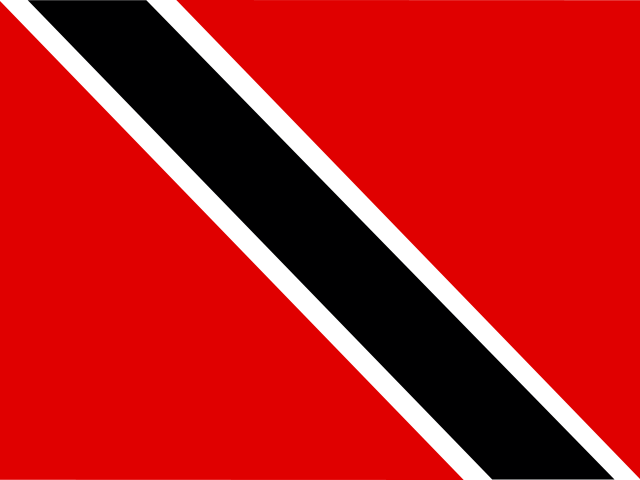
A red flag has a white-edged black diagonal band from upper left to lower right. Its colors represent the elements of earth, water, and fire; black also stands for the land's wealth and people's dedication. White stands for the sea, purity of the country's aspirations, equality; red stands for the sun, land vitality, people's courage and friendliness. National symbols are the scarlet ibis, bird of Trinidad; cocrico, bird of Tobago; and chaconia flower.
Source: CIA World Factbook · 2026-02-01 · text generated from this source, approved by a person
 Trinidad and Tobago