Overview
Background
A military power during the 17th century, Sweden maintained military non-alignment until it applied to join NATO in 2022. Stockholm preserved an armed neutrality in both World Wars. Since then, Sweden has pursued a successful economic formula consisting of a capitalist system intermixed with substantial welfare elements.
Sweden joined the EU in 1995, but the public rejected the introduction of the euro in a 2003 referendum. The share of Sweden’s population born abroad increased between 2000 and 2022.
Source: CIA World Factbook · 2026-02-01 · text generated from this source, approved by a person
Climate
Southern Sweden has a temperate climate, with cold, cloudy winters and cool, partly cloudy summers; the north is subarctic.
Source: CIA World Factbook · 2026-02-01 · text generated from this source, approved by a person
People and society
Swedish, Syrian, Iraqi, and Finnish people are among the country's ethnic groups, alongside others. Swedish is the official language. The Church of Sweden is Lutheran. Other affiliations include Roman Catholic, Orthodox, Baptist, Muslim, Jewish, and Buddhist traditions, while some people have no religion or have not specified one.
Most of the population lives in the south, where the climate is milder and connectivity to mainland Europe is better. Population clusters occur along the Baltic coast in the east. The interior areas of the north remain sparsely populated.
Source: CIA World Factbook · 2026-02-01 · text generated from this source, approved by a person
Government
A parliamentary constitutional monarchy governs Sweden. Its civil law system is influenced by Roman-Germanic law and customary law. The Instrument of Government, whose latest version is from 1974, is one of four fundamental laws making up the Constitution. Independence dates to 6 June 1523, when Gustav Vasa was elected king of Sweden, marking the abolishment of the Kalmar Union of Denmark, Norway, and Sweden. National Day is 6 June (1983).
Source: CIA World Factbook · 2026-02-01 · text generated from this source, approved by a person
Flag and symbols
A blue flag carries a golden yellow cross extending to its edges, shifted to the left side in the style of the Dannebrog, the Danish flag. The colors come from the Swedish coat of arms. The national symbols are three crowns and a lion.
Source: CIA World Factbook · 2026-02-01 · text generated from this source, approved by a person
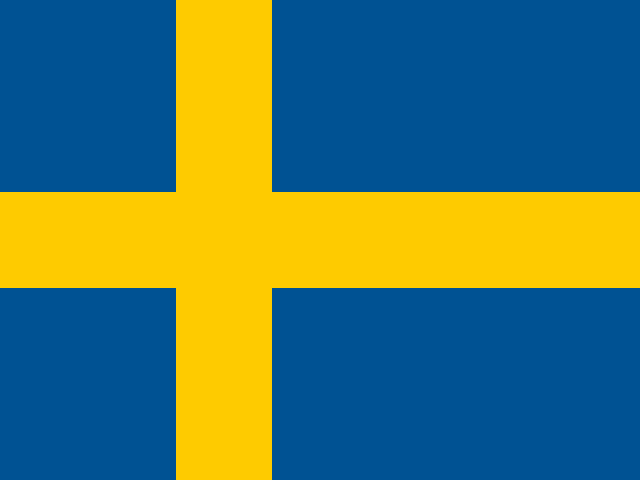 Sweden