11 cities

Location of FinlandGuernseyÅlandSwedenGermanyUnited KingdomNorwayIsle of ManJerseyFranceKazakhstanBelarusAustriaLuxembourgDenmarkNetherlandsLatviaLithuaniaSlovakiaEstoniaBelgiumUkrainePolandCzechiaFinlandHelsinkiVaasaKuopioPoriLappeenrantaTampereTurkuOuluLahtiJyvaskyla
Country

Finland

63.25° N, 27.28° E

7.75 per 1,000 births and 11.01 per 1,000 deaths per 1,000 people — the population is not growing at all.

population growth +0.02% · 178th/230 · birth rate 7.75 per 1,000 · 209th/226 · death rate 11.01 per 1,000 · 29th/226
CIA World Factbook · 2026-02-01 · ranks computed across the countries in this atlas that carry the value

Population
5,520,314
Area
338,145 km²
Population density
≈ 17 / km²
Capital
Helsinki
Natural Earth
ISO codes
FI · FIN
GDP (nominal)
$299.84 billion
GDP per capita (PPP)
$55,600
How big, reallyDrawn at the same scale as Ecuador — the next country down in size. Equal-area projection, not the map you are used to.
Finland 338,145 km²Ecuador 283,561 km²

geometry: Natural Earth 1:50m · EPSG:6933 equal-area

Where Finland sits in the world

Each line is every country in this atlas that carries the value, ordered smallest to largest. The line down the middle is the world median; the mark on each line is this country.

  1. Median age44 years32nd of 224 · median 32.6 years
  2. Life expectancy82.2 years31st of 224 · median 76.2 years
  3. Fertility rate1.28 children per woman206th of 225 · median 1.92 children per woman
  4. Population5,520,314117th of 235 · median 5,454,073
  5. Total area338,145 km²65th of 228 · median 83,736 km²
  6. Coastline1,250 km76th of 229 · median 402 km

Overview

Background

A Swedish province and later a grand duchy, Finland was under Sweden from the 12th to the 19th centuries. After 1809, it became an autonomous grand duchy of Russia before gaining complete independence in 1917. During World War II, Finland successfully defended its independence through cooperation with Germany and resisted subsequent invasions by the Soviet Union, while losing some territory. Over the next half-century, Finland changed from a farm/forest economy into a diversified modern industrial economy.

Finland joined the EU in 1995 and was the only Nordic state to join the euro single currency at its initiation in January 1999. In the 21st century, its modern welfare state centered on high-quality education, promotion of equality, and a national social welfare system. That system faced the challenges of an aging population and fluctuations in an export-driven economy. Following Russia's invasion of Ukraine in 2022, Finland opted to join NATO and became the organization's 31st member in April 2023.

Source: CIA World Factbook · 2026-02-01 · text generated from this source, approved by a person

Geography

Between Sweden and Russia, Finland lies in Northern Europe, bordering the Baltic Sea, the Gulf of Bothnia, and the Gulf of Finland. Finland has a long boundary with Russia, and Helsinki is the northernmost national capital on the European continent. Its population is concentrated on a small southwestern coastal plain.

Mostly low, flat to rolling plains are interspersed with lakes and low hills. Timber, iron ore, copper, lead, zinc, chromite, nickel, gold, silver, and limestone are natural resources. Halti, alternatively Haltia, Haltitunturi, or Haltiatunturi, is Finland's highest point. The Baltic Sea is Finland's lowest point.

Source: CIA World Factbook · 2026-02-01 · text generated from this source, approved by a person

People and society

Finnish, Swedish, Russian, Estonian, Romani, and Sami are among Finland's ethnic groups. Finnish and Swedish are official languages, while Russian and other languages are also spoken.

Lutheran, Greek Orthodox, and other religions are present in Finland. Some people have no religion. The vast majority of people are found in the south, while the northern interior areas remain sparsely populated.

Source: CIA World Factbook · 2026-02-01 · text generated from this source, approved by a person
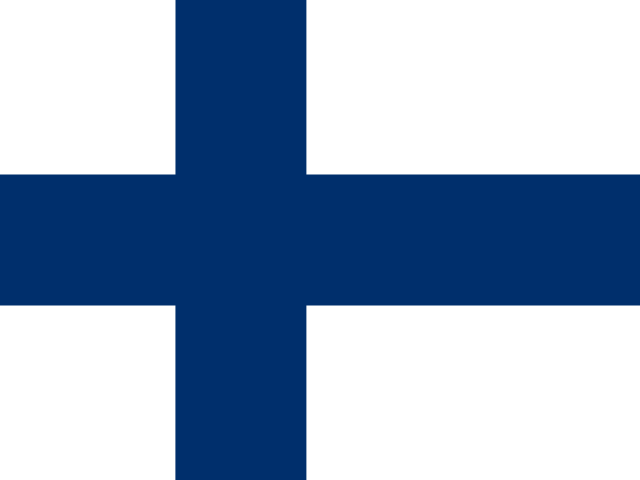
Key figures

CIA World Factbook

Economy

GDP (nominal)
$299.84 billion
GDP (PPP)
$313.59 billion
GDP per capita (PPP)
$55,600
GDP growth
-0.2%
Inflation (consumer prices)
1.6%
Unemployment
8.3%
Exports
$124.53 billion
Imports
$122.64 billion

People

Life expectancy
82.2 years
Median age
44 years
Birth rate
7.75 per 1,000
Death rate
11.01 per 1,000
Fertility rate
1.28 children per woman
Population growth
+0.02% a year
Urban population
85.8%
Languages
  • Finnishofficial85.9%
  • Swedishofficial5.2%
  • Russian1.7%
  • others7.2%
Religions
  • Lutheran66.6%
  • Greek Orthodox1.1%
  • other30.6%

Land

Total area
338,145 km²Land 303,815 km² · Water 34,330 km²
Coastline
1,250 km
Land borders
2,563 km
Mean elevation
164 m
Highest point
1,328 m Halti (alternatively Haltia, Haltitunturi, Haltiatunturi)

Values from the CIA World Factbook archive. Each carries the year it describes; open a year for the exact source field.

Connections

Natural geography 13

Natural Earth outlines · features with a Wikidata ID

Plateaus 1

Peninsulas 1

Geographic regions 3

Largest cities 11

Population · Natural Earth

  1. Helsinkicapital1.1M
  2. Tampere259.3K
  3. Turku175.9K
  4. Oulu136.8K
  5. Lahti98.8K
  6. Jyvaskyla98.1K
  7. Kuopio91.9K
  8. Pori76.8K
  9. Lappeenranta59.3K
  10. Vaasa57K
  11. Joensuu53.4K

Sources