46 cities · 10 districts · 34 places

Location of United KingdomSpainGreenlandItalyGuernseyÅlandVaticanNorth MacedoniaGreeceSwedenGermanyBosnia and HerzegovinaFaroe IslandsKosovoNorwayFinlandIsle of ManMoldovaJerseyAndorraFranceSan MarinoMonacoTürkiyeIcelandBelarusMontenegroAustriaLuxembourgSwitzerlandBulgariaDenmarkNetherlandsLatviaLithuaniaAlbaniaSlovakiaCroatiaSloveniaEstoniaBelgiumPortugalUkrainePolandLiechtensteinRomaniaIrelandCzechiaHungarySerbiaUnited KingdomLondonNewcastleNottinghamBirminghamManchesterLeedsSheffieldGlasgowCardiffLiverpool
Country

United Kingdom

54.40° N, 2.12° W

12,429 km of coast against 499 km of land border — this country faces the sea far more than it faces its neighbors.

coastline 12,429 km · 14th/229 · land borders 499 km · 141st/230
CIA World Factbook · 2026-02-01 · ranks computed across the countries in this atlas that carry the value

Population
66,834,405
Area
243,610 km²
Population density
≈ 278 / km²
Capital
London
Natural Earth
ISO codes
GB · GBR
GDP (nominal)
$3.64 trillion
GDP per capita (PPP)
$52,500
How big, reallyDrawn at the same scale as Kyrgyzstan — the next country down in size. Equal-area projection, not the map you are used to.
United Kingdom 243,610 km²Kyrgyzstan 199,951 km²

geometry: Natural Earth 1:50m · EPSG:6933 equal-area

Where United Kingdom sits in the world

Each line is every country in this atlas that carries the value, ordered smallest to largest. The line down the middle is the world median; the mark on each line is this country.

  1. Median age40.9 years57th of 224 · median 32.6 years
  2. Life expectancy82.2 years31st of 224 · median 76.2 years
  3. Fertility rate1.64 children per woman157th of 225 · median 1.92 children per woman
  4. Population66,834,40522nd of 235 · median 5,454,073
  5. Total area243,610 km²80th of 228 · median 83,736 km²
  6. Coastline12,429 km14th of 229 · median 402 km

Overview

Background

England and Scotland, distinct states under one monarchy, joined under the 1707 Acts of Union, creating the United Kingdom. The island of Ireland was incorporated under the 1800 Acts of Union, while Wales belonged to England since the 16th century. The 18th and 19th centuries saw rapid expansion of the British Empire despite the loss of the Thirteen Colonies.

Two World Wars in the first half of the 20th century seriously depleted the UK's strength, and the Irish Republic withdrew from the union. The second half saw the dismantling of the Empire and the UK's rebuilding into a modern and prosperous European nation. As a permanent UN Security Council member and founding member of NATO and the Commonwealth of Nations, the UK pursues global foreign policy. The devolved Scottish Parliament, National Assembly for Wales, and Northern Ireland Assembly were established in 1998. The UK joined the EU in 1973 but stayed outside the Economic and Monetary Union. In 2016, UK citizens voted to leave the EU. On 31 January 2020, the UK departed the EU after prolonged negotiations on economic and security relationships, a move known as Brexit.

Source: CIA World Factbook · 2026-02-01 · text generated from this source, approved by a person

People and society

The United Kingdom's people include White, Black/African/Caribbean/black British, Asian/Asian British: Indian, Asian/Asian British: Pakistani, mixed, and other ethnic groups. Christianity includes Anglican, Roman Catholic, Presbyterian, and Methodist traditions; Muslim and Hindu faiths, other religions, unspecified affiliations, and no religion are also present.

The population core lies in and around London, with significant clusters in central Britain around Manchester and Liverpool. Further clusters occupy the Scottish lowlands between Edinburgh and Glasgow, southern Wales around Cardiff, and far-eastern Northern Ireland centered on Belfast.

Source: CIA World Factbook · 2026-02-01 · text generated from this source, approved by a person

Flag and symbols

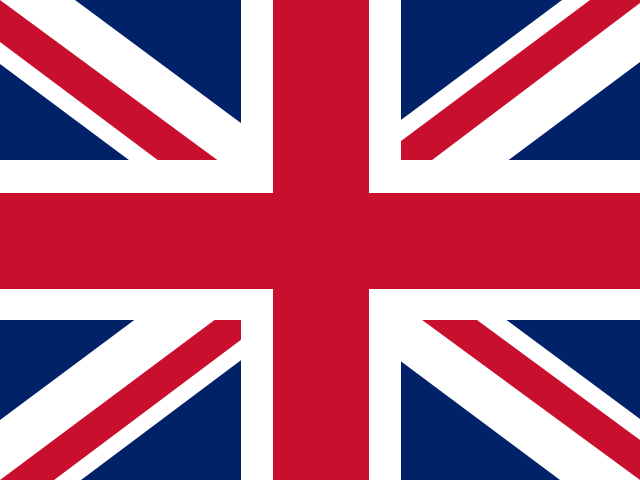
A blue field bears Saint George’s red cross, edged in white, atop Saint Patrick’s diagonal red cross, atop Saint Andrew’s diagonal white cross. It is officially the Union Flag, commonly called the Union Jack. National symbols include the lion for all of Britain; the lion, Tudor rose, and oak for England; the lion, unicorn, and thistle for Scotland. Wales has the dragon, daffodil, and leek; Northern Ireland has shamrock and flax.

Source: CIA World Factbook · 2026-02-01 · text generated from this source, approved by a person
Key figures

CIA World Factbook

Economy

GDP (nominal)
$3.64 trillion
GDP (PPP)
$3.64 trillion
GDP per capita (PPP)
$52,500
GDP growth
+1.1%
Inflation (consumer prices)
3.3%
Unemployment
4.2%
Exports
$1.12 trillion
Imports
$1.16 trillion

People

Life expectancy
82.2 years
Median age
40.9 years
Birth rate
10.76 per 1,000
Death rate
9.25 per 1,000
Fertility rate
1.64 children per woman
Population growth
+0.4% a year
Urban population
84.6%
Languages
  • English
Religions
  • Christian59.5%includes Anglican, Roman Catholic, Presbyterian, Methodist
  • Muslim4.4%
  • Hindu1.3%
  • other25.7%

Land

Total area
243,610 km²Land 241,930 km² · Water 1,680 km²
Coastline
12,429 km
Land borders
499 km
Mean elevation
162 m
Highest point
1,345 m Ben Nevis

Values from the CIA World Factbook archive. Each carries the year it describes; open a year for the exact source field.

Connections

Natural geography 18

Natural Earth outlines · features with a Wikidata ID

Largest cities 46

Population · Natural Earth

  1. Londoncapital8.6M
  2. Birmingham2.3M
  3. Manchester2.2M
  4. Leeds1.5M
  5. Sheffield1.3M
  6. Glasgow1.2M
  7. Newcastle882K
  8. Cardiff861.4K
  9. Nottingham825.6K
  10. Liverpool811K
  11. Southend-on-Sea618.4K
  12. Bristol553.5K

Sources