13 cities

Location of NetherlandsColombiaSpainCayman IslandsSint MaartenGreenlandBritish Virgin IslandsSaint Kitts and NevisTurks and Caicos IslandsItalyMaltaBermudaGuernseyÅlandBarbadosVaticanSaint BarthélemyNorth MacedoniaSaint Pierre and MiquelonDominican RepublicBosnia and HerzegovinaSaint Vincent and the GrenadinesAntigua and BarbudaFaroe IslandsWestern SaharaGreeceSwedenGermanyUnited States Virgin IslandsFinlandPanamaMoldovaSudanMaliGuatemalaLibyaGuyanaHaitiHondurasUnited KingdomPuerto RicoKosovoSaint MartinSan MarinoMonacoAnguillaBelizeIsle of ManSaint LuciaEgyptTürkiyeTrinidad and TobagoIcelandNorwayJerseyAndorraFranceCuraçaoArubaVenezuelaCanadaBelarusAustriaLuxembourgSwitzerlandBulgariaDenmarkLatviaLithuaniaBrazilAlbaniaMontserratSlovakiaCroatiaSloveniaEstoniaBelgiumJamaicaPortugalUkraineAlgeriaPolandMoroccoRomaniaChadTunisiaCubaIrelandMauritaniaSurinameBahamasCzechiaHungarySerbiaNicaraguaCosta RicaGrenadaEl SalvadorMontenegroDominicaMexicoLiechtensteinNetherlandsLeeuwardenRotterdamEindhovenGroningenUtrechtArnhemHaarlem's-HertogenboschAmsterdamThe Hague
CountryTranscontinental

Netherlands

52.42° N, 5.61° E

Mean elevation of 30 m — the 7th lowest of 168 countries.

mean elevation 30 m · 162nd/168
CIA World Factbook · 2026-02-01 · ranks computed across the countries in this atlas that carry the value

Population
17,332,850
Area
41,543 km²
Population density
≈ 465 / km²
Capital
Amsterdam
Natural Earth
ISO codes
NL · NLD
GDP (nominal)
$1.23 trillion
GDP per capita (PPP)
$70,900
How big, reallyDrawn at the same scale as Armenia. Equal-area projection, not the map you are used to.
Netherlands 41,543 km²Armenia 29,743 km²

geometry: Natural Earth 1:50m · EPSG:6933 equal-area

Where Netherlands sits in the world

Each line is every country in this atlas that carries the value, ordered smallest to largest. The line down the middle is the world median; the mark on each line is this country.

  1. Median age42.2 years46th of 224 · median 32.6 years
  2. Life expectancy81.9 years37th of 224 · median 76.2 years
  3. Fertility rate1.62 children per woman163rd of 225 · median 1.92 children per woman
  4. Population17,332,85067th of 235 · median 5,454,073
  5. Total area41,543 km²133rd of 228 · median 83,736 km²
  6. Coastline451 km109th of 229 · median 402 km

Overview

Name

The English name comes from the country's Dutch name, meaning "the lowlands" and describing its geographic area.

Source: CIA World Factbook · 2026-02-01 · text generated from this source, approved by a person
Climate

A temperate marine climate has cool summers and mild winters.

Source: CIA World Factbook · 2026-02-01 · text generated from this source, approved by a person

People and society

The Randstad, anchored by Amsterdam, Rotterdam, the Hague, and Utrecht, is the most densely populated region. The population includes Dutch, EU (excluding Dutch), Turkish, Moroccan, Surinamese, Indonesian, and others. Dutch is an official language, and Frisian is official in Fryslan province. People identify as Roman Catholic, Protestant, Muslim, Hindu, Buddhist, Jewish, or as having no religion. Protestant includes Dutch Reformed, Protestant Church of The Netherlands, and Calvinist.

The north tends to be less dense, while sizeable communities can be found throughout the entire country.

Source: CIA World Factbook · 2026-02-01 · text generated from this source, approved by a person

Flag and symbols

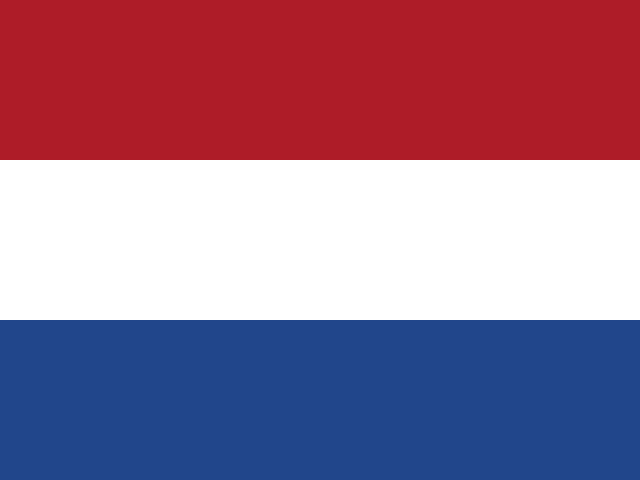
Three equal horizontal bands form the flag: bright red at the top, followed by white and cobalt blue. The colors come from William I, Prince of Orange; the upper band was originally orange, but the dye would turn red over time, so red became permanent. The national symbols are the lion and daisy.

Source: CIA World Factbook · 2026-02-01 · text generated from this source, approved by a person

Key figures

CIA World Factbook

Economy

GDP (nominal)
$1.23 trillion
GDP (PPP)
$1.28 trillion
GDP per capita (PPP)
$70,900
GDP growth
+1%
Inflation (consumer prices)
3.3%
Unemployment
3.6%
Exports
$1.03 trillion
Imports
$884.15 billion

People

Life expectancy
81.9 years
Median age
42.2 years
Birth rate
10.68 per 1,000
Death rate
9.7 per 1,000
Fertility rate
1.62 children per woman
Population growth
+0.3% a year
Urban population
93.2%
Languages
  • Dutchofficial
  • Frisianofficial
Religions
  • Roman Catholic20.1%
  • Protestant14.8%includes Dutch Reformed, Protestant Church of The Netherlands, Calvinist
  • Muslim5%
  • other54.1%

Land

Total area
41,543 km²Land 33,893 km² · Water 7,650 km²
Coastline
451 km
Land borders
1,053 km
Mean elevation
30 m
Highest point
862 m Mount Scenery (on the island of Saba in the Caribbean, now considered an integral part of the Netherlands following the dissolution of the Netherlands Antilles)

Values from the CIA World Factbook archive. Each carries the year it describes; open a year for the exact source field.

Connections

Natural geography 4

Natural Earth outlines · features with a Wikidata ID

Largest cities 13

Population · Natural Earth

  1. The Haguecapital1.4M
  2. Amsterdamcapital1M
  3. Rotterdam1M
  4. Utrecht640K
  5. Eindhoven398.1K
  6. Haarlem350K
  7. Groningen216.7K
  8. Arnhem141.7K
  9. 's-Hertogenbosch134.5K
  10. Leeuwarden125.8K
  11. Maastricht122.4K
  12. Zwolle111.8K

Sources