Name
In the 10th century, early Norse explorer Floki Vilgerdarson applied the name "Land of Ice," from the local words "ís" for ice and "land" for land.
Source: CIA World Factbook · 2026-02-01 · text generated from this source, approved by a person
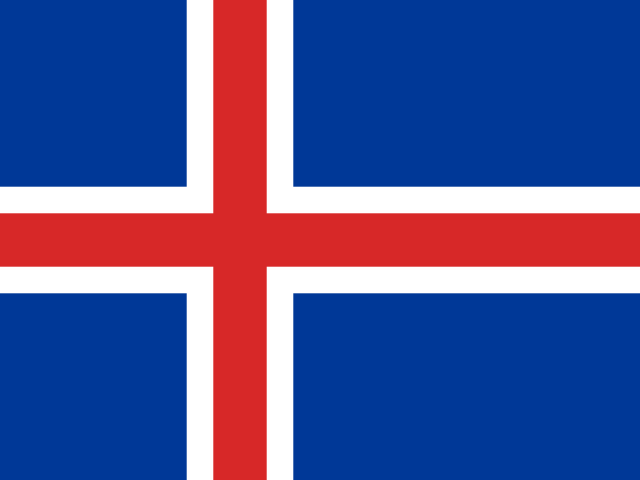 Iceland
64.78° N, 18.67° W
No land border at all — every neighbor is across water, along 4,970 km of coast, the 27th longest on Earth.
land borders 0 km · 164th/230 · coastline 4,970 km · 27th/229
CIA World Factbook · 2026-02-01 · ranks computed across the countries in this atlas that carry the value
geometry: Natural Earth 1:50m · EPSG:6933 equal-area
Each line is every country in this atlas that carries the value, ordered smallest to largest. The line down the middle is the world median; the mark on each line is this country.
In the 10th century, early Norse explorer Floki Vilgerdarson applied the name "Land of Ice," from the local words "ís" for ice and "land" for land.
Source: CIA World Factbook · 2026-02-01 · text generated from this source, approved by a person
The Althingi, Iceland's legislative assembly, was established in 930 and is the world's oldest functioning legislative assembly. Norwegian and Celtic (Scottish and Irish) immigrants settled Iceland during the late 9th and 10th centuries CE. After being independent for over 300 years, Iceland was subsequently ruled by Norway and Denmark. Fallout from the Askja volcano in 1875 devastated the Icelandic economy and caused widespread famine. Over the next quarter-century, some of the island's population emigrated, mostly to Canada and the US.
Denmark granted limited home rule in 1874 and complete independence in 1944. During the second half of the 20th century, economic growth was driven primarily by the fishing industry. After Iceland joined the European Economic Area in 1994, its economy diversified greatly. The global financial crisis hit Iceland especially hard in the years after 2008. The economy is now on an upward trajectory, primarily thanks to a tourism and construction boom.
Source: CIA World Factbook · 2026-02-01 · text generated from this source, approved by a person
Moderated by the North Atlantic Current, Iceland has a temperate climate with mild, windy winters and damp, cool summers.
Source: CIA World Factbook · 2026-02-01 · text generated from this source, approved by a person
Iceland's people include Icelandic, Polish, Danish, Ukrainian, and other ethnic groups. The Evangelical Lutheran Church of Iceland is official, alongside Roman Catholic, Independent Congregation of Reykjavik, and Independent Congregation of Hafnarfjordur affiliations. Pagan worship and the Icelandic Ethical Humanist Association are also present, along with other or unspecified affiliations and people identifying with none.
Iceland is almost entirely urban, with the population concentrated in and around the capital of Reykjavik. Smaller clusters are found primarily along the coast in the north and west.
Source: CIA World Factbook · 2026-02-01 · text generated from this source, approved by a person
CIA World Factbook
Values from the CIA World Factbook archive. Each carries the year it describes; open a year for the exact source field.
Natural Earth outlines · features with a Wikidata ID
Population · Natural Earth