Name
Christopher Columbus named the island Dominica for Sunday, "Domingo" in Spanish and "dominica dies" in Latin, after spotting it on 3 November 1493.
Source: CIA World Factbook · 2026-02-01 · text generated from this source, approved by a person
 Dominica
15.46° N, 61.34° W
No land border at all — every neighbor is across water, along 148 km of coast, the 149th longest on Earth.
land borders 0 km · 164th/230 · coastline 148 km · 149th/229
CIA World Factbook · 2026-02-01 · ranks computed across the countries in this atlas that carry the value
geometry: Natural Earth 1:50m · EPSG:6933 equal-area
Each line is every country in this atlas that carries the value, ordered smallest to largest. The line down the middle is the world median; the mark on each line is this country.
Christopher Columbus named the island Dominica for Sunday, "Domingo" in Spanish and "dominica dies" in Latin, after spotting it on 3 November 1493.
Source: CIA World Factbook · 2026-02-01 · text generated from this source, approved by a person
Tropical conditions are moderated by northeast trade winds, with heavy rainfall. Flash floods are a constant threat, and destructive hurricanes can be expected during late summer.
Source: CIA World Factbook · 2026-02-01 · text generated from this source, approved by a person
People live along the coast, including in the parish of St. George, in or around the capital of Roseau. The volcanic interior is sparsely populated.
Dominica's ethnic groups include people of African descent, people of mixed descent, Indigenous people, and others. Religious affiliations include Roman Catholic, Protestant, Jehovah's Witness, Rastafarian, other faiths, and no religious affiliation. Protestant communities include Seventh Day Adventist, Pentecostal, Baptist, Christian Union Church, Methodist, Gospel Mission, and other Protestant groups.
Source: CIA World Factbook · 2026-02-01 · text generated from this source, approved by a person
A parliamentary republic is Dominica's form of government. Its legal system is based on common law modeled on the English system. The latest constitution was presented 25 July 1978 and entered into force 3 November 1978. Independence from the UK dates to 3 November 1978. Independence Day, 3 November (1978), is the national holiday.
Source: CIA World Factbook · 2026-02-01 · text generated from this source, approved by a person
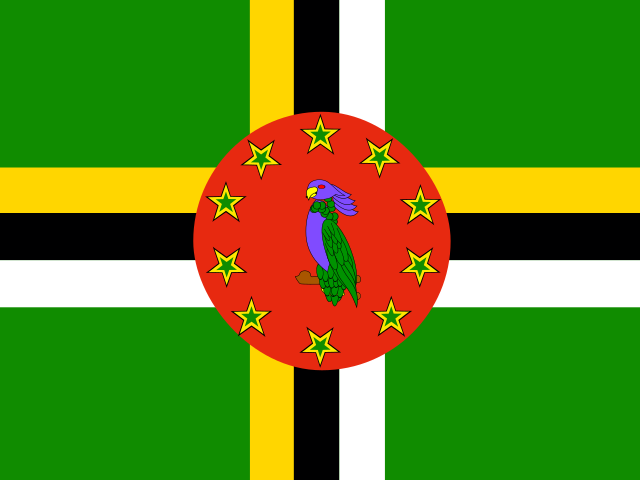
A green flag has a centered cross of three equal bands in yellow, black, and white, plus a red disk with a Sisserou parrot surrounded by ten five-pointed green stars edged in yellow. Green symbolizes lush vegetation; the cross represents the Christian Trinity; yellow stands for sunshine, citrus, bananas, and Carib people; black for rich soil and African heritage; red for social justice. National symbols include sisserou parrot and Carib wood flower.
Source: CIA World Factbook · 2026-02-01 · text generated from this source, approved by a person
CIA World Factbook
Values from the CIA World Factbook archive. Each carries the year it describes; open a year for the exact source field.
Natural Earth outlines · features with a Wikidata ID
Population · Natural Earth