Name
The country name Djibouti derives from its capital city, Djibouti.
Source: CIA World Factbook · 2026-02-01 · text generated from this source, approved by a person
 Djibouti
11.98° N, 42.50° E
Life expectancy of 65.9 years — the 26th lowest of 224 countries.
life expectancy 65.9 years · 199th/224
CIA World Factbook · 2026-02-01 · ranks computed across the countries in this atlas that carry the value
geometry: Natural Earth 1:50m · EPSG:6933 equal-area
Each line is every country in this atlas that carries the value, ordered smallest to largest. The line down the middle is the world median; the mark on each line is this country.
The country name Djibouti derives from its capital city, Djibouti.
Source: CIA World Factbook · 2026-02-01 · text generated from this source, approved by a person
Between Eritrea and Somalia, Djibouti borders the Gulf of Aden and the Red Sea in Eastern Africa. Its terrain combines a coastal plain and plateau, separated by central mountains. Lac Assal, also called Lake Assal, is Africa's lowest point and the world's saltiest lake.
Moussa Ali is the highest point. Lac Assal is the lowest point. Natural resources include potential geothermal power, gold, clay, granite, limestone, marble, salt, diatomite, gypsum, pumice, and petroleum. Its strategic location lies near the world's busiest shipping lanes and close to Arabian oilfields.
Source: CIA World Factbook · 2026-02-01 · text generated from this source, approved by a person
A presidential republic governs Djibouti. Its legal system is a mixed system based primarily on the French civil code (as it existed in 1997), Islamic religious law in matters of family law and successions, and customary law. The constitution was approved by referendum 4 September 1992. Djibouti gained independence from France on 27 June 1977. Its national holiday is Independence Day, 27 June (1977).
Source: CIA World Factbook · 2026-02-01 · text generated from this source, approved by a person
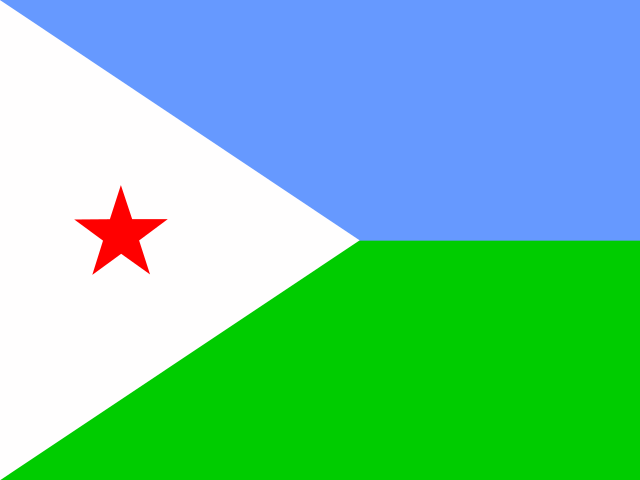
The flag has two equal horizontal bands: light blue on top and light green below. A white isosceles triangle based on the left side contains a five-pointed red star at its center. Blue stands for sea, sky, and the Issa Somali people; green for earth and the Afar people; white for peace, while the red star stands for the struggle for independence and unity. The national symbol is the red star.
Source: CIA World Factbook · 2026-02-01 · text generated from this source, approved by a person
CIA World Factbook
Values from the CIA World Factbook archive. Each carries the year it describes; open a year for the exact source field.
Natural Earth outlines · features with a Wikidata ID
Population · Natural Earth