23 cities

Location of CubaCayman IslandsBritish Virgin IslandsTurks and Caicos IslandsDominican RepublicUnited States Virgin IslandsPuerto RicoGuatemalaHaitiHondurasBelizeJamaicaMexicoBahamasCubaHavanaGuantanamoSantiago de CubaLas TunasCamagueyHolguinSanta ClaraBayamoPinar del RioCienfuegos
Country

Cuba

21.33° N, 77.98° W

For every 7.78 per 1,000 births there are 11.42 per 1,000 deaths — the population is falling 0.6% a year.

population growth -0.6% · 215th/230 · birth rate 7.78 per 1,000 · 207th/226 · death rate 11.42 per 1,000 · 22nd/226
CIA World Factbook · 2026-02-01 · ranks computed across the countries in this atlas that carry the value

Population
11,333,483
Area
110,860 km²
Population density
≈ 104 / km²
Capital
Havana
Natural Earth
ISO codes
CU · CUB
GDP (nominal)
$259.78 billion
GDP per capita (PPP)
$23,700
How big, reallyDrawn at the same scale as Hungary — the next country down in size. Equal-area projection, not the map you are used to.
Cuba 110,860 km²Hungary 93,028 km²

geometry: Natural Earth 1:50m · EPSG:6933 equal-area

Where Cuba sits in the world

Each line is every country in this atlas that carries the value, ordered smallest to largest. The line down the middle is the world median; the mark on each line is this country.

  1. Median age46.2 years15th of 224 · median 32.6 years
  2. Life expectancy80.1 years56th of 224 · median 76.2 years
  3. Fertility rate1.49 children per woman183rd of 225 · median 1.92 children per woman
  4. Population11,333,48381st of 235 · median 5,454,073
  5. Total area110,860 km²106th of 228 · median 83,736 km²
  6. Coastline3,735 km33rd of 229 · median 402 km

Overview

Geography

Between the Caribbean Sea and the North Atlantic Ocean, Cuba is an island south of Key West, Florida. It is the largest country in the Caribbean and the westernmost island of the Greater Antilles. Its terrain consists of mostly flat to rolling plains, with rugged hills and mountains in the southeast.

Cuba's natural resources include cobalt, nickel, iron ore, chromium, copper, salt, timber, silica, petroleum, and arable land. Pico Turquino is the country's highest point. The Caribbean Sea is the country's lowest point.

Source: CIA World Factbook · 2026-02-01 · text generated from this source, approved by a person

People and society

Cuba brings together people identified as White, Mulatto or mixed, and Black. Spanish is Cuba's official language.

Cuba has Christian, folk religion, Buddhist, Hindu, Jewish, and Muslim affiliations, as well as people with no religion. Population clusters occur throughout Cuba, with more significant clusters in larger towns and cities, particularly the capital of Havana.

Source: CIA World Factbook · 2026-02-01 · text generated from this source, approved by a person

Government

It is a communist state. Its legal system is a civil law system based on Spanish civil code. The latest constitution was drafted 14 July 2018, approved by the National Assembly 22 December 2018, and approved by referendum 24 February 2019. Independence is listed as 20 May 1902 from US administration and 10 December 1898 from Spain; the Cuban Government does not acknowledge these as days of independence. Triumph of the Revolution (Liberation Day) is the national holiday, on 1 January (1959).

Source: CIA World Factbook · 2026-02-01 · text generated from this source, approved by a person

Flag and symbols

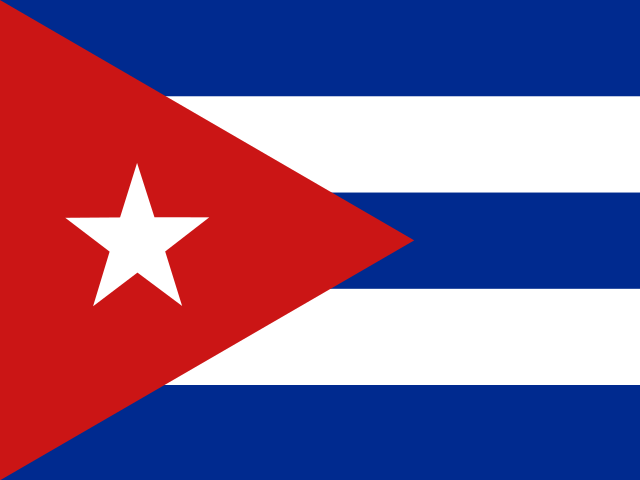
Five equal horizontal bands alternate blue and white; blue appears at the top, center, and bottom. A red equilateral triangle based on the left side contains a five-pointed white star at its center. The triangle stands for liberty, equality, and fraternity; red for blood shed in the independence struggle. The star, called "La Estrella Solitaria," lights the way to freedom. The royal palm is a national symbol.

Source: CIA World Factbook · 2026-02-01 · text generated from this source, approved by a person
Key figures

CIA World Factbook

Economy

GDP (nominal)
$259.78 billion
GDP (PPP)
$81.17 billion
GDP per capita (PPP)
$23,700
GDP growth
-1.9%
Inflation (consumer prices)
76.1%
Unemployment
1.6%
Exports
$8.77 billion
Imports
$8.07 billion

People

Life expectancy
80.1 years
Median age
46.2 years
Birth rate
7.78 per 1,000
Death rate
11.42 per 1,000
Fertility rate
1.49 children per woman
Population growth
-0.6% a year
Urban population
77.5%
Literacy
97.7%
Languages
  • Spanishofficial

Land

Total area
110,860 km²Land 109,820 km² · Water 1,040 km²
Coastline
3,735 km
Land borders
29 km
Mean elevation
108 m
Highest point
1,974 m Pico Turquino

Values from the CIA World Factbook archive. Each carries the year it describes; open a year for the exact source field.

Connections

Natural geography 8

Natural Earth outlines · features with a Wikidata ID

Islands 1

Largest cities 23

Population · Natural Earth

  1. Havanacapital2.2M
  2. Santiago de Cuba555.9K
  3. Camaguey347.6K
  4. Holguin319.1K
  5. Guantanamo272.8K
  6. Santa Clara250.5K
  7. Las Tunas203.7K
  8. Bayamo192.6K
  9. Pinar del Rio187K
  10. Cienfuegos186.6K
  11. Matanzas146.7K
  12. Ciego de Avila142K

Sources