Overview
Name
The name comes from the Congo River, which makes up much of the country's eastern border. The river's name derives from "Kongo," a Bantu kingdom in the area.
Source: CIA World Factbook · 2026-02-01 · text generated from this source, approved by a person
Background
Upon independence in 1960, the former French region of Middle Congo became the Republic of the Congo. From 1968 to 1992, the country was named the People’s Republic of the Congo. The country abandoned Marxism in 1990, and a democratically elected government took office in 1992, when the country reverted to the name Republic of the Congo. A civil war that ended in 1999 restored former President Denis Sassou-Nguesso to power, after he had ruled from 1979 to 1992.
A new constitution provided for a multi-party system and a presidential term, and the next elections retained Sassou-Nguesso. After renewed fighting, Sassou-Nguesso and southern-based rebel groups agreed to a final peace accord in 2003. Following a constitutional referendum allowing him to run for additional terms, Sassou-Nguesso was reelected in 2009 and again in 2016 and 2021. The Republic of the Congo is a petroleum producer in Africa.
Source: CIA World Factbook · 2026-02-01 · text generated from this source, approved by a person
Climate
Astride the Equator, Congo has a tropical climate with persistent high temperatures and humidity, making it particularly enervating. Its rainy season runs from March to June, while the dry season extends from June to October.
Source: CIA World Factbook · 2026-02-01 · text generated from this source, approved by a person
People and society
The population includes Kongo (Bakongo), Teke, Mbochi, foreigner, Sangha, Mbere/Mbeti/Kele, and Punu. They also include Pygmy, Oubanguiens, Duma, and Makaa. French is official; French Lingala and Monokutuba are trade languages, alongside many local languages and dialects. Kikongo is the most widespread of the local languages and dialects.
Religious affiliations include Roman Catholic, Awakening Churches/Christian Revival, Protestant, Salutiste, Muslim, and Kimbanguist; some have none. People live primarily in the south, in and around the capital of Brazzaville.
Source: CIA World Factbook · 2026-02-01 · text generated from this source, approved by a person
Flag and symbols
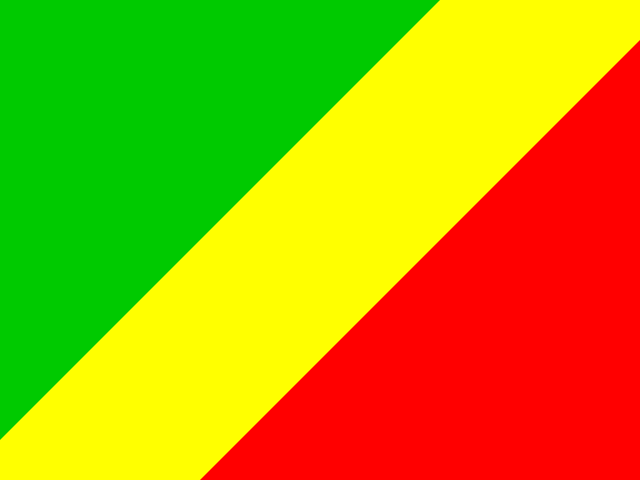
A wide yellow band divides the flag diagonally from the lower-left side; the upper triangle on the left is green, and the lower triangle is red. Green stands for agriculture and forests, while yellow stands for the people's friendship and nobility; the meaning of red is not noted but has been associated with the struggle for independence. The national symbols are the lion and elephant.
Source: CIA World Factbook · 2026-02-01 · text generated from this source, approved by a person
 Congo
Congo