Name
The name honors Juan de Bermudez, an early 16th-century Spanish sea captain and the archipelago's first European explorer.
Source: CIA World Factbook · 2026-02-01 · text generated from this source, approved by a person
 Bermuda
32.30° N, 64.76° W
100% of everyone here lives in a city.
urban population 100% · 1st/225
CIA World Factbook · 2026-02-01 · ranks computed across the countries in this atlas that carry the value
geometry: Natural Earth 1:50m · EPSG:6933 equal-area
Each line is every country in this atlas that carries the value, ordered smallest to largest. The line down the middle is the world median; the mark on each line is this country.
The name honors Juan de Bermudez, an early 16th-century Spanish sea captain and the archipelago's first European explorer.
Source: CIA World Factbook · 2026-02-01 · text generated from this source, approved by a person
Shipwrecked English colonists heading for Virginia first settled Bermuda in 1609. Bermuda has been self-governing since 1620 and is the oldest and most populous of the British Overseas Territories.
Vacationing on the island to escape North American winters first developed in Victorian times. Tourism continues to be important to the island's economy, although international business has overtaken it in recent years as Bermuda developed into an offshore financial center. A referendum on independence from the UK was soundly defeated in 1995.
Source: CIA World Factbook · 2026-02-01 · text generated from this source, approved by a person
A group of islands in the North Atlantic Ocean, east of South Carolina, lies in North America. Bermuda's archipelago consists of coral islands and islets, with ample rainfall, but no rivers or freshwater lakes.
Low hills separated by fertile depressions form the terrain. Limestone is a natural resource, and the pleasant climate fosters tourism. Town Hill is the highest point. The Atlantic Ocean is the lowest point.
Source: CIA World Factbook · 2026-02-01 · text generated from this source, approved by a person
Its subtropical climate is mild and humid, with gales and strong winds common in winter.
Source: CIA World Factbook · 2026-02-01 · text generated from this source, approved by a person
People of African descent, White, mixed, and Asian backgrounds, as well as others, live in Bermuda.
Religious affiliations include Protestant traditions such as Anglican, African Methodist Episcopal, Seventh Day Adventist, Pentecostal, Methodist, Presbyterian, Church of God, Baptist, Salvation Army, Brethren, and other Protestant traditions. Roman Catholic, Jehovah's Witness, other Christian, and Muslim affiliations are also present, alongside people reporting other faiths, none, or unspecified affiliations. The population is distributed relatively evenly throughout Bermuda.
Source: CIA World Factbook · 2026-02-01 · text generated from this source, approved by a person
With limited self-government, Bermuda is an Overseas Territory of the UK and a parliamentary democracy. English common law forms its legal system. The latest constitution entered into force 8 June 1968 under the Bermuda Constitution Order 1968. Bermuda has no independence as an overseas territory of the UK; its national holiday is Bermuda Day, 24 May.
Source: CIA World Factbook · 2026-02-01 · text generated from this source, approved by a person
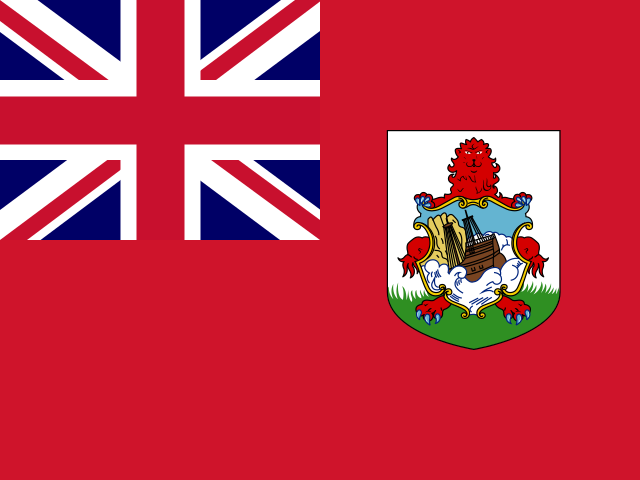
A red field carries the UK flag in the upper-left quadrant and the Bermudian coat of arms centered on its right half. The coat of arms is a white shield with a red lion on a green field, holding a scroll showing the sinking of the ship "Sea Venture." The red lion is Bermuda's national symbol.
Source: CIA World Factbook · 2026-02-01 · text generated from this source, approved by a person
CIA World Factbook
Values from the CIA World Factbook archive. Each carries the year it describes; open a year for the exact source field.
Natural Earth outlines · features with a Wikidata ID
Population · Natural Earth