Overview
Name
The name Vietnam translates as "Viet south": "Viet" is an ethnic term of unknown origin dating back to ancient times, while "nam" means south and refers to the country's location.
Source: CIA World Factbook · 2026-02-01 · text generated from this source, approved by a person
Background
Centered on the Red River Valley, the area passed through outside occupation before Vietnamese dynastic families consolidated power. Han Chinese emperors ruled it until approximately the 10th century. The Ly Dynasty (11th-13th century) created Dai Viet, the first independent Vietnamese state, and established its capital at Thang Long (Hanoi). Under the Tran Dynasty (13th-15th century), Tran Hung Dao led Dai Viet forces against Mongol invaders in 1279. After a brief Chinese occupation in the early 1400s, Le Thai To established the Le Dynasty, which lasted until the late 18th century. Dai Viet expanded southward, reaching the approximate boundaries of modern-day Vietnam by the 1750s. It reunited and became Vietnam under Emperor Nguyen Phuc Anh (aka Gia Long) in 1802.
France began its conquest in 1858 and made Vietnam part of French Indochina in 1887. Vietnam declared independence after World War II, but France continued ruling until communist forces under Ho Chi Minh defeated it in 1954. The Geneva Accords divided Vietnam into a communist North and anti-communist South in 1954. Fighting soon erupted, with the North supporting communist rebels in the South. US assistance to the South included economic and military support, while US combat forces withdrew after a cease-fire agreement in 1973. In 1975, North Vietnamese forces overran the South and reunited the country under communist rule. The Second Indochina War, fought from 1955-1975, devastated Vietnam and spilled into Cambodia and Laos. Since the 'doi moi' (renovation) policy began in 1986, the economy has seen strong growth in agricultural and industrial production, construction, exports, foreign investment, and tourism. The Communist Party maintains tight political and social control, alongside challenges including rising income inequality and corruption.
Source: CIA World Factbook · 2026-02-01 · text generated from this source, approved by a person
Geography
Son Doong in Phong Nha-Ke Bang National Park is the world's largest cave by cross-sectional area. It contains its own jungle, underground river, and localized weather system. Clouds form inside and spew from its exits.
The country borders the Gulf of Thailand, Gulf of Tonkin, and South China Sea, as well as China, Laos, and Cambodia. The terrain has low, flat deltas in the south and north, central highlands, and hilly, mountainous areas in the far north and northwest. Natural resources include antimony, phosphates, coal, manganese, rare earth elements, bauxite, chromate, offshore oil and gas deposits, timber, hydropower, and arable land. Fan Si Pan is the highest point. The South China Sea is the lowest point.
Source: CIA World Factbook · 2026-02-01 · text generated from this source, approved by a person
People and society
Population is dense but unevenly dispersed, with clustering heaviest along the South China Sea and Gulf of Tonkin. The Mekong Delta in the south and the Red River Valley in the north have the largest concentrations of people. Kinh (Viet), Tay, Thai, Muong, Khmer, Mong, and Nung are among the ethnic groups living in Vietnam, alongside others.
Vietnamese is the official language; English is often used as a second language, alongside some French, Chinese, and Khmer. Mountain-area languages include Mon-Khmer and Malayo-Polynesian languages. Catholic, Buddhist, Protestant, and other religious affiliations are present, while some people have none.
Source: CIA World Factbook · 2026-02-01 · text generated from this source, approved by a person
Flag and symbols
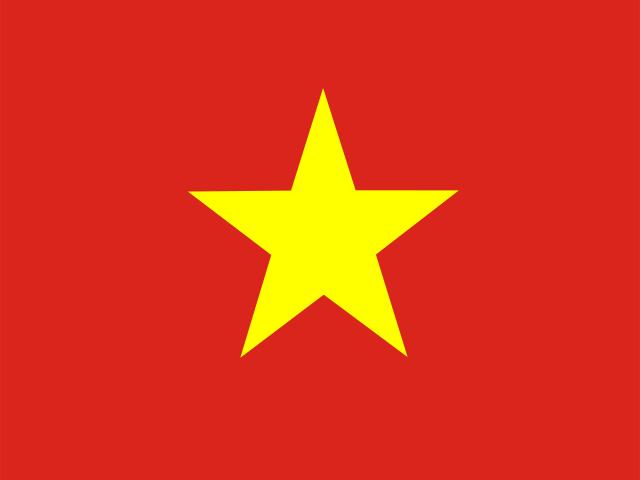
A red field carries a five-pointed yellow star in the center, forming the flag. Red stands for revolution and blood, while the star represents the five elements of the populace—peasants, workers, intellectuals, traders, and soldiers—that unite to build socialism. National symbols include the five-pointed yellow star on a red field and the lotus blossom.
Source: CIA World Factbook · 2026-02-01 · text generated from this source, approved by a person
 Vietnam