Overview
Name
The name is an anglicized form of the Dutch "Nieuw Zeeland," meaning "New Sea Land." It was first used in 1643 in honor of the Dutch province of Zeeland.
Source: CIA World Factbook · 2026-02-01 · text generated from this source, approved by a person
Background
Polynesians settled New Zealand between the late 1200s and the mid-1300s, calling the land Aotearoa, now widely used as its local Maori name. By the 1500s, competition for land and resources brought intermittent fighting among Maori tribes. Abel Tasman saw the islands in 1642, and British sea captain James Cook arrived in 1769, followed by whalers, sealers, and traders. The UK nominally claimed New Zealand, included it as part of New South Wales in Australia, and declared it a separate colony in 1841. Some Maori tribes declared independence in 1835; fearing French settlement and takeover, the majority of Maori chiefs signed the Treaty of Waitangi with the British in 1840.
New Zealand changed its status to an independent dominion in 1907, provided troops during each World War, and reaffirmed its independence in 1947. Beginning in 1984, New Zealand adopted nuclear-free policies, and the US suspended its defense obligations in 1986 after a dispute over naval ship visits. Auckland balances concerns over China’s growing influence with China’s role as New Zealand's largest export destination; close ties with Australia reflect common colonial origins and military history.
Source: CIA World Factbook · 2026-02-01 · text generated from this source, approved by a person
Climate
Temperate conditions show sharp regional contrasts across New Zealand.
Source: CIA World Factbook · 2026-02-01 · text generated from this source, approved by a person
People and society
People include European, Maori, Chinese, Indian, Samoan, Tongan, Cook Islands Maori, English, Filipino, New Zealander, and others. Christian affiliations include Catholic, Anglican, Presbyterian and Congregational, Pentecostal, Methodist, Church of Jesus Christ, and other Christian affiliations. Hindu, Maori, Muslim, Buddhist, and other religions are also represented, alongside people with no religion or who objected to answering.
New Zealanders, including the Maori, live on the North Island, primarily in urban areas.
Source: CIA World Factbook · 2026-02-01 · text generated from this source, approved by a person
Government
No single constitution document exists; the Constitution Act 1986 took effect 1 January 1987 and includes only part of the uncodified constitution. New Zealand is a parliamentary democracy under a constitutional monarchy and a Commonwealth realm. Its common law system is based on the English model, with special legislation and land courts for the Maori. New Zealand's independence from the UK dates to 26 September 1907. National holidays include Waitangi Day, 6 February (1840), and Anzac Day, 25 April (1915).
Source: CIA World Factbook · 2026-02-01 · text generated from this source, approved by a person
Flag and symbols
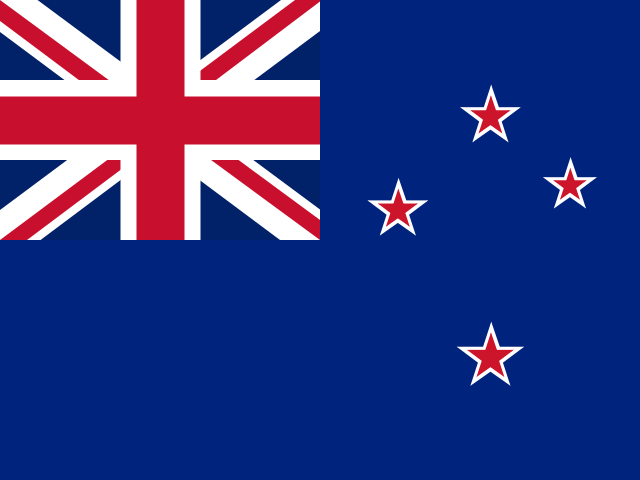
Blue carries the UK flag in its upper-left quadrant and four five-pointed red stars edged in white, centered in the right half. The stars represent the Southern Cross constellation. National symbols include the Southern Cross constellation, with its four five-pointed stars, the kiwi (bird), and the silver fern.
Source: CIA World Factbook · 2026-02-01 · text generated from this source, approved by a person
 New Zealand