Overview
Background
Ethnic Kazakhs derive from a mix of Turkic nomadic tribes that migrated to the region in the 15th century. The Russian Empire conquered the Kazakh steppe in the 18th and 19th centuries, before Kazakhstan became a Soviet Republic in 1925. Forced agricultural collectivization brought repression and starvation in the early 1930s. During the 1950s and 1960s, the agricultural 'Virgin Lands' program brought settlers from multiple nationalities, including ethnic Russians. By the time of Kazakhstan's independence in 1991, ethnic Kazakhs were a minority. After non-Muslim ethnic minorities departed Kazakhstan from the mid-1990s through the mid-2000s, a national program repatriated ethnic Kazakhs from Uzbekistan, Tajikistan, Mongolia, and the Xinjiang region of China.
Kazakhstan's economy is the largest in Central Asia, due to the country's vast natural resources. Current issues include diversifying the economy, attracting foreign direct investment, and enhancing Kazakhstan's economic competitiveness. They also include strengthening economic relations with neighboring states and foreign powers.
Source: CIA World Factbook · 2026-02-01 · text generated from this source, approved by a person
Geography
Kazakhstan lies in Central Asia, northwest of China, with a small portion west of the Ural (Oral) River in easternmost Europe. A vast flat steppe extends from the Volga in the west to the Altai Mountains in the east, and from the plains of western Siberia in the north to oases and deserts of Central Asia in the south.
Its natural resources include major deposits of petroleum, natural gas, coal, iron ore, manganese, chrome ore, nickel, cobalt, copper, molybdenum, lead, zinc, bauxite, gold, and uranium. Pik Khan-Tengri is the country's highest point. Qauyndy Oyysy is the country's lowest point.
Source: CIA World Factbook · 2026-02-01 · text generated from this source, approved by a person
Climate
Cold winters and hot summers define Kazakhstan's continental climate, which is arid and semiarid.
Source: CIA World Factbook · 2026-02-01 · text generated from this source, approved by a person
Government
A presidential republic is the form of government. Its legal system is a civil law system influenced by Roman-Germanic law and by the theory and practice of Russia. The current constitution was approved by referendum 30 August 1995 and became effective 5 September 1995. Independence came on 16 December 1991 from the Soviet Union. The national holiday is Independence Day, 16 December (1991).
Source: CIA World Factbook · 2026-02-01 · text generated from this source, approved by a person
Flag and symbols
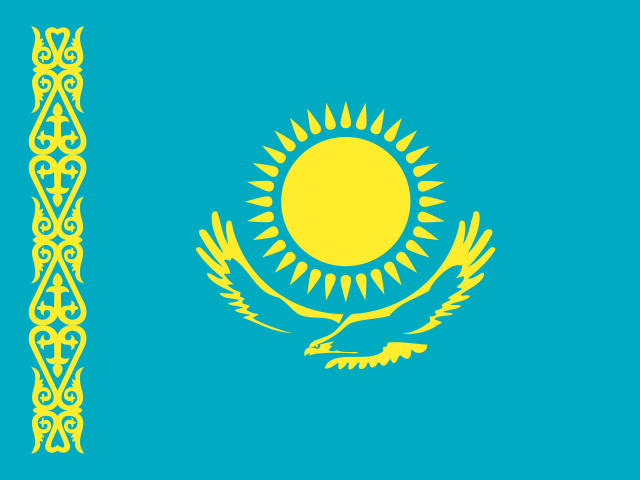
A gold sun with rays above a soaring golden steppe eagle, both centered on a sky-blue background; the left side displays the gold koshkar-muiz pattern, meaning ram's horns. Blue has religious significance for the Turkic peoples and symbolizes cultural and ethnic unity, sky and water; the sun stands for wealth and plenitude. The eagle represents freedom, power, and the flight to the future. The national symbol is the golden eagle.
Source: CIA World Factbook · 2026-02-01 · text generated from this source, approved by a person
 Kazakhstan