Name
The name Cook Islands comes from Captain James Cook, the British explorer who visited the islands in 1773 and 1777.
Source: CIA World Factbook · 2026-02-01 · text generated from this source, approved by a person
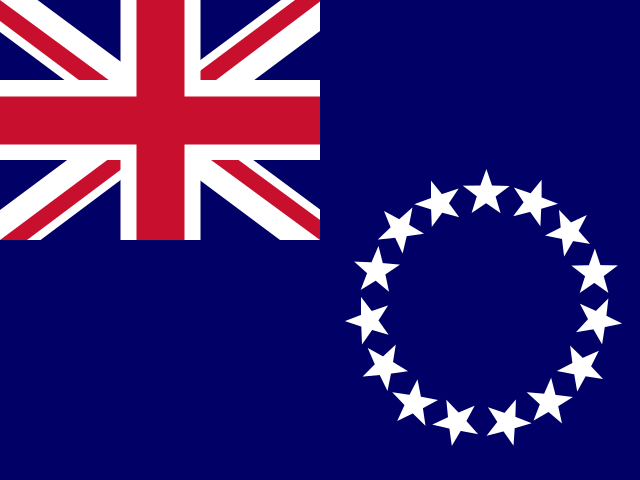 Cook Islands
21.22° S, 159.79° W
For every 11.85 per 1,000 births there are 9.48 per 1,000 deaths — the population is falling 2.15% a year.
population growth -2.15% · 230th/230 · birth rate 11.85 per 1,000 · 137th/226 · death rate 9.48 per 1,000 · 47th/226
CIA World Factbook · 2026-02-01 · ranks computed across the countries in this atlas that carry the value
geometry: Natural Earth 1:50m · EPSG:6933 equal-area
Each line is every country in this atlas that carries the value, ordered smallest to largest. The line down the middle is the world median; the mark on each line is this country.
The name Cook Islands comes from Captain James Cook, the British explorer who visited the islands in 1773 and 1777.
Source: CIA World Factbook · 2026-02-01 · text generated from this source, approved by a person
Its people include Cook Island Maori, part Cook Island Maori, Fijian, New Zealand Maori/European, Filipino, people from other Pacific Islands, and others. Religious affiliations include Protestant (Cook Islands Christian Church, Seventh Day Adventist, and Assemblies of God), Roman Catholic, Church of Jesus Christ, Jehovah’s Witness, Apostolic Church, and people reporting none or no specification.
Most of the population is found on the island of Rarotonga.
Source: CIA World Factbook · 2026-02-01 · text generated from this source, approved by a person
A parliamentary democracy governs the Cook Islands. Its legal system is common law similar to New Zealand common law. The constitution took effect on 4 August 1965 under the Cook Islands Constitution Act 1964. On 4 August 1965, the Cook Islands became a self-governing state in free association with New Zealand. Constitution Day is the national holiday, observed on the first Monday in August and dating to 1965.
Source: CIA World Factbook · 2026-02-01 · text generated from this source, approved by a person
CIA World Factbook
Values from the CIA World Factbook archive. Each carries the year it describes; open a year for the exact source field.
Natural Earth outlines · features with a Wikidata ID