Name
In Arabic, the name means "the two seas," referring to the water bodies on each side of the archipelago.
Source: CIA World Factbook · 2026-02-01 · text generated from this source, approved by a person
 Bahrain
26.06° N, 50.55° E
No land border at all — every neighbor is across water, along 161 km of coast, the 143rd longest on Earth.
land borders 0 km · 164th/230 · coastline 161 km · 143rd/229
CIA World Factbook · 2026-02-01 · ranks computed across the countries in this atlas that carry the value
geometry: Natural Earth 1:50m · EPSG:6933 equal-area
Each line is every country in this atlas that carries the value, ordered smallest to largest. The line down the middle is the world median; the mark on each line is this country.
In Arabic, the name means "the two seas," referring to the water bodies on each side of the archipelago.
Source: CIA World Factbook · 2026-02-01 · text generated from this source, approved by a person
The Sunni Al-Khalifa family took power in Bahrain in 1783 and later made it a British protectorate through treaties with the UK during the 19th century. The archipelago attained independence in 1971. Declining oil production and reserves since 1970 prompted economic diversification into petroleum processing and refining, aluminum production, hospitality, and retail. Bahrain also sought to become a leading regional banking center, especially in Islamic finance.
Small size, central location among Gulf countries, economic dependence on Saudi Arabia, and proximity to Iran require delicate balancing among larger neighbors. Its foreign policy usually follows Saudi Arabia and the UAE, and in 2022 the United States designated Bahrain a major non-NATO ally. The Sunni royal family has long struggled to manage relations with Bahrain's Shia-majority population. In 2011, amid Arab uprisings elsewhere in the region, the Bahraini Government responded to pro-democracy and reform protests with police and military action, including deploying Gulf Cooperation Council security forces. Ongoing dissatisfaction with the political status quo continues to factor into sporadic clashes between demonstrators and security forces. In 2020, Bahrain and the United Arab Emirates signed the US-brokered Abraham Accords with Israel. In 2023, Bahrain and the United States signed the Comprehensive Security Integration and Prosperity Agreement, covering defense, security, emerging technology, trade, and investment.
Source: CIA World Factbook · 2026-02-01 · text generated from this source, approved by a person
The climate is arid, with mild, pleasant winters and very hot, humid summers. Periodic droughts and dust storms are natural hazards.
Source: CIA World Factbook · 2026-02-01 · text generated from this source, approved by a person
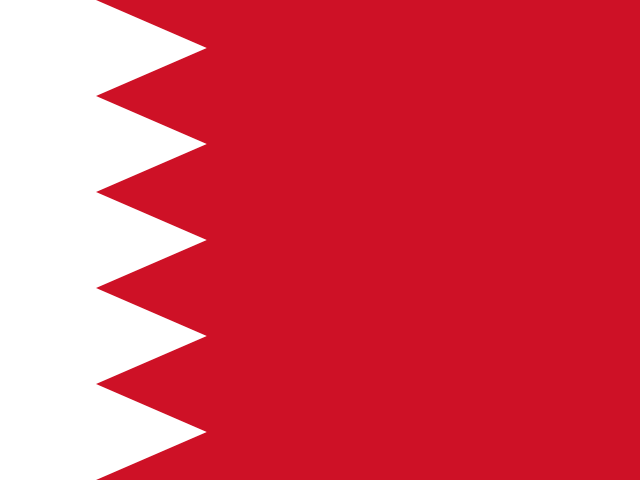
A red flag has a white serrated band of five white points on the left side. Red is the traditional color for flags of Persian Gulf states, while the five points represent the five pillars of Islam. Until 2002, the flag had eight white points, reduced to five to avoid confusion with the Qatari flag. The national symbol is a white serrated band with five white points on top of a red field.
Source: CIA World Factbook · 2026-02-01 · text generated from this source, approved by a person
CIA World Factbook
Values from the CIA World Factbook archive. Each carries the year it describes; open a year for the exact source field.
Natural Earth outlines · features with a Wikidata ID
Population · Natural Earth