Overview
Name
The Latin "australis," meaning "southern," gives Australia its name. The Australian landmass was long referred to as "Terra Australis," or the Southern Land. Its conventional long form is Commonwealth of Australia.
Source: CIA World Factbook · 2026-02-01 · text generated from this source, approved by a person
Background
Aboriginal Australians developed complex hunter-gatherer societies and oral histories before European settlement brought disease and a policy removing children from their parents. Dutch navigators led by Abel Tasman first landed in Australia in 1606, naming it New Holland. In 1770, Englishman James Cook reached the east coast, named it New South Wales, and claimed it for Great Britain. Great Britain established New South Wales and Tasmania as penal colonies in 1788 and 1825. Western Australia, South Australia, Victoria, and Queensland became colonies in 1829, 1836, 1851, and 1859, while gold rushes beginning in the 1850s brought new immigrants. After gradual self-government, the colonies federated as the Commonwealth of Australia in 1901.
Australia contributed to Allied efforts in world wars, while its troops helped defeat Japanese troops in the Pacific during World War II. It severed constitutional links with the UK in 1942 but remained part of the British Commonwealth; by the 1970s, ending racial immigration policies increased Asian immigration. Post-war growth, 1980s reforms, and proximity to East and Southeast Asia contributed to an internationally competitive, advanced market economy. Frequent attempts to oust party leaders destabilized politics in the early 2000s, prompting both major parties to make removal harder.
Source: CIA World Factbook · 2026-02-01 · text generated from this source, approved by a person
Geography
Australia lies in Oceania between the Indian Ocean and the South Pacific Ocean. Mostly low plateau and deserts shape its terrain, with a fertile plain in the southeast. Australia is the world's smallest continent, the largest country in Oceania, and the largest country without land borders. The Great Dividing Range runs along eastern Australia, forming a watershed crest from which all rivers of eastern Australia flow east, west, north, and south.
Australia is the only continent without glaciers and the driest inhabited continent on earth. Mount Kosciuszko is Australia's highest point. Lake Eyre is its lowest point. Natural resources include alumina, coal, iron ore, copper, lithium, tin, gold, silver, uranium, nickel, tungsten, and rare earth elements.
Source: CIA World Factbook · 2026-02-01 · text generated from this source, approved by a person
Climate
From tropical conditions in the north to temperate conditions in the south and east, the climate is generally arid to semiarid. Cyclones occur along the coast, and severe droughts also affect the country.
Source: CIA World Factbook · 2026-02-01 · text generated from this source, approved by a person
People and society
The country's people include English, Australian, Irish, Scottish, Chinese, Italian, German, Indian, Australian Aboriginal, and Greek identities. Religious affiliations include Roman Catholic, Protestant, other Christian, Muslim, Hindu, Buddhist, Orthodox, and other traditions. Protestant affiliations include Anglican, Uniting Church, Presbyterian and Reformed, Baptist, Pentecostal, and other Protestant traditions. Orthodox affiliations include Eastern Orthodox and Oriental Orthodox; some have no religion, while others have an unspecified affiliation.
The population is primarily located on the country's periphery, with the highest concentration of people in the east and southeast. A secondary population center is located in and around Perth in the west. New South Wales has, by far, the largest population among the states and territories, while the interior, or 'outback,' has a very sparse population.
Source: CIA World Factbook · 2026-02-01 · text generated from this source, approved by a person
Government
A federal parliamentary democracy under a constitutional monarchy, Australia is a Commonwealth realm. Its legal system is a common law system based on the English model. Approved in a series of referenda from 1898 through 1900, the Constitution became law 9 July 1900 and took effect 1 January 1901. Australia became independent on 1 January 1901 from the federation of UK colonies. Australia Day commemorates the arrival of the First Fleet of Australian settlers on 26 January (1788). ANZAC Day commemorates the anniversary of the landing of troops of the Australian and New Zealand Army Corps during World War I at Gallipoli, Türkiye, on 25 April (1915).
Source: CIA World Factbook · 2026-02-01 · text generated from this source, approved by a person
Flag and symbols
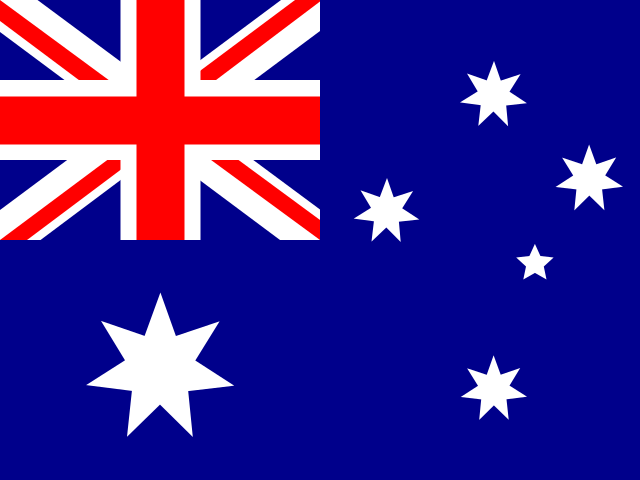
Blue carries the UK flag upper-left and a large seven-pointed star lower-left. The right half shows the white Southern Cross constellation: one small five-pointed and four larger seven-pointed stars. The Commonwealth or Federation Star represents the federation of Australia's colonies in 1901. Six points represent the original states; one represents Australia's internal and external territories. National symbols include Commonwealth Star (seven-pointed Star of Federation), golden wattle (Acacia pycnantha), kangaroo, and emu.
Source: CIA World Factbook · 2026-02-01 · text generated from this source, approved by a person
 Australia